There is no better time than the present to get interested in a career in welding.
Regardless of the are you’re in, the fight for clean energy will be in a constant rate of growth. Eventually, we will be living in an entirely green economy, it’s inevitable. The thing to pay attention to now are the fields that’re going to make people the most money.
A few examples of green energy sources are:
Ethanol
Solar
Natural Gas
Water
Wind
Etc.
Considering there are so many industries where green energy is so important, it makes sense to simply look for the common denominators in all of the industries. Now, since we know that developing a society to the point where they could utilize each of these methods on a full scale would require a lot of metal we can deduce that the best filed to be in would be one that requires constant interaction with metal. One of the fields we know has this requirement is metal fabrication or welding.
Welding is what many would call a green collar job – one that has a huge demand even in our economy. It is incredibly challenging to find a welder with enough skill to complete complicated projects, which is why it’s so profitable to learn and be skilled at welding.
It’s important to keep in mind that welding is a job that is profitable to work in even without the green industries. There are a number of welding jobs available to talented welding professionals. When the green energy initiative goes into full swing, it’s important to make sure that you have already learned enough about welding to be considered a skilled individual. Once it does take off, companies will be willing to pay much more than they currently do for welders. Many companies already have training areas set up to train their own skilled metal fabricators. It’s important to be good enough at fabrication that you’re able to perform at a high level in almost any area of welding.
Not only is welding an area where individuals have the capability of working in green areas but welders also have access to a wide number of other things.
Such as: Traveling all over the globe
Working in exotic areas
Making more money than those in the most esteemed positions
Making a difference in their community
Other Green Collar Jobs To Watch Out For
[table id=94 /]
While none of us really know what energy solutions will actually make it, we can be sure that whatever does make it will require a welder. If the ability to push the world into sustainability isn’t enough to motivate you into action, how about the ability to make 6+ figures without having to get a four or more-year college degree?
In an earlier article we mentioned that all exceptional welders have basic math skills. These skills are necessary if you plan to ever get good at the craft, for reasons that may not be so obvious. In reality, when we say fitter math we are referring to the basic algebra that we are forced to learn in a high school setting. The fact of the matter is that it’s kind of challenging to weld properly and pick up jobs if it’s difficult for you to measure angles and perform simple calculations.
Just remember, it isn’t as hard as you think
It’s common knowledge that many people get frightened when they see even a bit of math. In reality, we all think that things that involve math require us to do things the “hard” way. In reality, when you force yourself to perform trial and error experiments all of the time because you don’t know the formulas that will get you the exact measurements you need to get it right the first time you try. When you first look at fitter math we ask that you do one thing, keep an open mind. It isn’t as hard as we make it seem.
As with welding, when you first approach fitter math you have to be incredibly patient. You likely won’t get it right on your first try but as you keep learning I’m sure that you’ll figure it out. Despite the fact that it will save you quite a bit of time, it will also make sure that your clients are always happy with the work you do for them.
The connection between reading blueprints and fitter math
Before we open up on this section of the article, we ask you one thing – when you first start looking at blueprints don’t think everything is about the symbols, because it isn’t.
Why? Because welding is not all about knowing welding symbols – it’s more about knowing the math that goes into welding. We say this because it’s much easier to weld if you know how to weld efficiently, which means, with math. The symbols that are apart of welding can easily be learned on the job, the math can’t.
Keep in mind that when you’re welding many of the blueprints that you come into contact with won’t have the exact reference points that you need. Another thing to keep in mind is that a majority of engineers also make the mistake of overlooking certain key details that are necessary for the weld to be performed. Don’t blame the engineer because they also have tight schedule and relatively large workloads. When you first get your hands on a new blueprint it’s helpful to take a seat and figure out exactly where you’re likely to run into an engineer induced mistake.
It may not seem like it but, fitter math is probably the best option you have
If you want to save yourself sometime in the long run learning fitter math is probably your best choice. If you want to spend a great deal of time on each and every one your projects, then continue using the trial-and-error method of fabrication. If you want to be precise in your movements, then we suggest that you learn fitter math.
Welding is a process whereby metals and other materials are pieced together using pressure – this pressure can sometimes be utilized to create beautiful things. The pressure used in welding is pooled together with heat to change the shape of the materials being welded to the desire of the welder. To piece the metals together, the welder must use filler material that is compatible with the weld so as to make sure that a solid weld joint is formed. Welding is a simple process; it’s intended to join multiple pieces of metal together to form something more. On the other hand, there is a process called structural welding that requires a bit more skill than basic welding. This is because of the variety of colors and shapes that are involved in the process.
Who are a few metal fabrication artists?
Listed below we have several famous metal working artists and links to their respective websites.
As with any process, you are bound to encounter defects in the process. You can encounter things such as misshapes and off sizing of the metal. This can occur due to either a bad welding process or bad technique. Listed below are the most common defects that you’re likely to find.
There are 2 types of welding defects: External Welding Defects and Internal Welding Defects.
Overlap is the considered a protrusion of weld metal beyond the weld root. Overlap typically occurs in butt joints and fillet welds and results in notches occurring at the toe of the weld. These notches are undesirable due to the stress concentration that occurs under load. These discontinuities are caused by either insufficient current or incorrect welding technique.
How does overlap occur in welding?
Overlap in welding occurs when the molten metal from the weld flows over the surface of the base material and then cools without fusing to the base material. A common cause of overlap in welding is having too much weld metal supplied because of the weld speed being too low. When there is overlap in fillet welds it’s typically caused by the effect of gravity on excessive molten metal.
How do you fix overlap in welding?
To avoid overlap you must make sure to review your welding settings (welding speed and current).
Video credits to Weld.com. It goes over ways to prevent weld overlap.
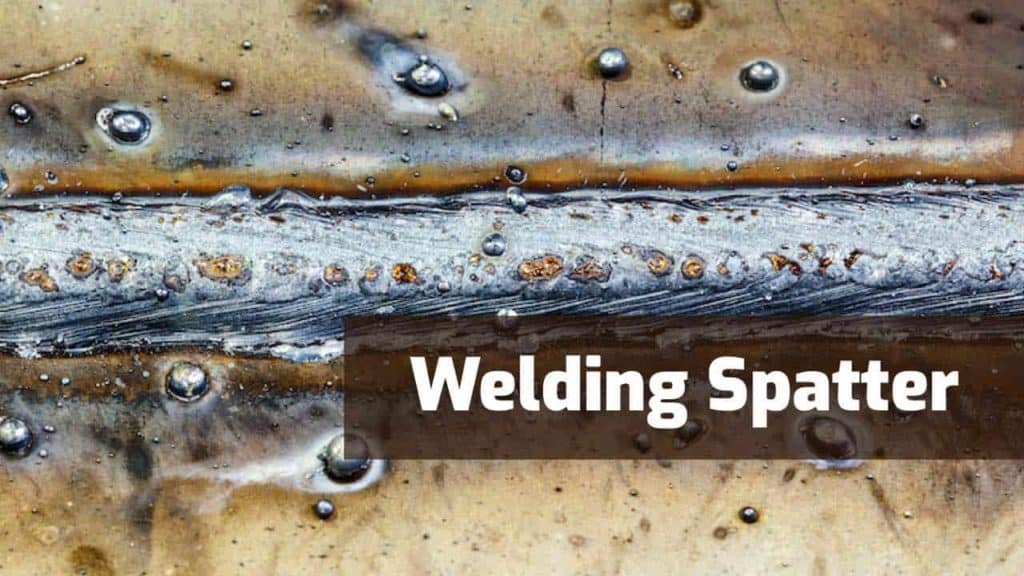
Spatter
What is spatter in welding?
When you have particles that attach to the surrounding areas of the surface the result is spatter. Surprisingly it’s pretty common in welds done with gas metal arc welding. It’s also one of the defects that you can’t completely eliminate, no matter how hard you try. It is, however, possible to keep its occurrence as low as possible.
How does spatter occur in welding?
When your amperage is too high
When the setting of voltage is too low
When your welding surface is contaminated
When your arc is long
When you have an incorrect polarity
How do you fix spatter?
Make sure you welding surface is clean before you weld
A serious complication that many welders tend to encounter during the process are cracks in the weld. These cracks can manifest anywhere in the weld, such as in the metal, on the surface, or anywhere else that touches the heat of the welder.
The different types of cracks are:
Heat cracks
Cold cracks
Crater cracks
What are heat cracks in welding?
These typically occur in the crystallization portion of the welding process. Temperatures of the metal at this point typically rises to over 10000C
What are cold cracks in welding?
These types of cracks typically show up after the weld has been finished. They can sometimes take longer than average periods to show and will manifest as slight deformities in the metal.
What are crater cracks in welding?
These types of cracks tend to show at the end of the entire process and occur at the end of the weld. When there is not enough room at the end of the weld for shrinkage of the weld metal a crater crack forms.
Why do welding cracks occur?
When you use hydrogen while welding ferrous metals
When there’s residual stress from the solidification shrinkage
When the base metal is contaminated
When you are welding with a high welding speed but with a low current
When you don’t preheat before you weld
When there’s a bad joint design
When there’s a high sulfur content and alot of carbon in your metal
Make sure that the gas flow to the machine is properly adjusted
Reduce your arc travel speed
Make sure you have the correct electrodes
Weld with the correct technique
Video credits to Miller Welders. It goes over how to fix porosity in your welds – The right way!
Undercut
What are undercuts in welding?
When you have a groove formation at the weld toe you come into contact with this imperfection. When you have an undercut you have a weakened weld.
Why does undercutting occur?
When you weld with too high a current
When you weld to quickly
When you use an incorrect angle when you weld
When the electrode you weld with is too large
When you use an incorrect amount of shielding gas
When you don’t have the right filler metal
How do you fix undercutting in welding?
Use the correct electrode angle
Make your arc length shorter
Weld with a lower electrode travel speed
Weld with the correct shielding gas
Use the right electrode angle
Video credits to Herbert Bartley. It talks about how to avoid undercut in welds.
What are Internal Welding Defects?
Unfinished Penetration
What is Unfinished Pentration in welding?
When the groove of the metal isn’t filled completely the result is an incomplete penetration. This also means that the weld metal won’t fully extend throughout the thickness of the joint.
How do unfinished penetrations occurs?
When there is to much space in the metal you’re welding
When you move the bead too quickly
When you’re using too low of an amperage setting
When there is too large of an electrode diameter
When there is an improper joint
How do you fix unfinished penetration in welding?
Make sure to have a proper joint geometry
Have a properly electrode size
Reduce your overall arc travel speed
Make sure to have the correct welding current
Have the correct alignment
Video credits to Kevin Caron, Artist. It goes over way to make sure you get good welding penetration.
When you neglect to clean the weld pass and move on to another one.
When you have an incorrect welding angle
When your weld pool cools too quickly
When the current you use to weld is too low
How do you fix slag in the weld?
Make your current denser
Fix the cooling rate of the weld
Fix the angle of the electrode
Remove the slag from the bead
Fix the speed of the weld
Video credits to xAZAZELx13. This video goes over how to repair slag in the weld.
Unfinished Fusion
What is unfinished fusion?
When there isn’t a proper fusion in the base of the weld and in the weld metal you have an improper fusion. You can also find this in the adjoining beads of the weld. When you have unfinished fusion, you have a weld with gaps that don’t have molten metal in them.
Why do unfinished fusions occur?
When you don’t have enough heat
When the surface of the weld is contaminated
When you have an incorrect electrode angle
When you weld with too fast a travel speed
How do you fix unfinished fusion?
Make sure to use the correct arc voltage for your weld
Clean the metal before you weld
Keep the molten metal from flooding the arc
Lower your disposition rate
Necklace Cracking
What is Necklace cracking in welding?
Necklace cracking occurs when the electron beam weld doesn’t fully penetrate fully and a blind weld occurs. In these instances molten metal neglects to flow into the penetration cavity and onto the side walls of the workpiece. This occurs in metals such as is carbon steel, nickel base alloys, stainless steel, titanium alloy.
What is the cause of necklace cracking in welding?
The common causes of necklace cracking in welding are:
In short, cold welding (aka contact welding) is a solid-state welding process that bonds 2 pieces of material together by applying pressure to them both. The pressure applied to the pieces of metal breaks up the oxide layers and allows the two pieces of material to stick to one another. You don’t have to worry about applying heat to or melting materials with cold welding.
Pros
Reduces the necessary skills for welding exotic metals
Makes it possible to join a number of metals that are dissimilar and would be otherwise difficult to weld
Gives a near perfect welding joint without brittle intermetallic compounds, microfractures, and other joint weaknesses
Eliminates most heat affected zone (HAZ) problems since there is no concentrated heat and because of this, no HAZ, from the welding arc
Is a perfect process for welding aluminum, especially in joining copper with aluminum, two metals that would typically be a challenge to join with other welding processes
Cons
It is difficult to weld irregular shapes, and the best results are gotten with flat surfaces
Difficult to achieve in industrial settings because of the debris that float in the air
Carbon steel and hardened metal can’t be cold welded, this only works with non-ferrous ductile metal like copper, gold, aluminum, lead, etc.
Surfaces must be cleaned pristinely; meaning that multiple steps of cleaning may have to be taken and the metal may have to be prepped
Surface irregularities, contamination, and nanoscale molecular structures can hurt the results
How does cold welding work?
When you have 2 pieces of material without a solid oxide layer, the atoms on the exposed sides of the materials collapse into one another. This is essentially how cold welding works. The union of the two materials can fail if they are in either a reactive or oxygen intense environment. For cold welding to be effective both surfaces must be cleaned thoroughly and free of contaminants.
Video credits to Cody’sLab. It demonstrates (or attempts to demonstrate) cold welding in a vacuum chamber.
For cold welding to work the two surfaces being welded must essentially be both clean and flat (anatomically so). The bond produced will be equal to the strength of the parent metal.
What metals can be cold welded?
Cold welding can only be used on non-ferrous metals or soft iron with no carbon content. The most common metals used for cold welding are aluminum and copper. However, there are other metals one can use such as:
Cold welding is typically used to weld wires together, especially between metals that are dissimilar. This method of welding is great when one is laying underground wires and there is the danger of flammable gasses catching fire from welding processes that are heat inducing.
On top of this, this method of welding is used to seal containers that’re sensitive to heat, like containers with explosives for example.
Cold welding is generally used when heat will damage the product or may present a danger.
Requirements for cold welding
The main requirements for cold welding are prepping the joint’s geometry and a clean metal surface. Joint surfaces that are flat work best, so flattening any irregularities in the shape is what’s recommended.
The oxide layer and any other impurities can be removed by degreasing, wire brushing, or chemical or mechanical methods. There will typically be oil and grease on the surface of the metal that will have to be removed before wire brushing. This is necessary since the brush can force the impurities deeper into the metal. Thanks to the wire brush’s sharp bristles, soft metal like silver, gold, copper, aluminum, and many others are more susceptible to getting surface oils embedded below the surface.
After the oils are cleaned, one can continue to strip away the oxide layer itself. Varying with the metal, different brush types and bristle materials may be recommended. It’s always a good idea to check the metal’s specification sheet.
Is cold welding strong?
Colded welded joints are as strong as the parent metal if it is properly prepped. Joint strength varies with the metal’s properties. Unlike with other welding methods, cold welding joint strength can’t outperform the original metal strength.
Joint strength will be compromised if the joining surfaces aren’t cleaned sufficiently enough or are irregularly shaped. For typical cold-welding applications such as joining wire, the maximum bond isn’t very hard to achieve.
What are the possible weld joints?
Because cold pressure welding is best done on large contact surfaces, it’s best to use lap and butt joints.
Butt welds are typically used when welding pipes and wires together. This is because it’s simple to trim the ends, put clean metal onto the contact surface, and press the two wires together.
When you’re making a butt weld, the distance between the clamping points and the contact surface should not be too large since soft metals can always bend sideways rather than join together.
Cold lap joints can be tricky. By pressing sheet metal together you’ll reduce the thickness of it because of the applied pressure. Meaning that one should account for at least a 50 percent thickness when you’re prepping the project. Without that, the final part won’t meet the requirements of the project.
The project may be perfect, but the thinned part isn’t acceptable. One should consider the metals softness and ductility and perform a few test welds to determine the thickness that will occur as a result.
Machines that cold weld and can join wires
Cold welders are hand operated for wires with small diameters. But larger diameters need a pneumatic or electric-pneumatic operation. Many of these machines are portable and can handle strips, wires, and rods.
Making use of an air hydraulic intensifier, cold welders generate extreme pressure. On the operator’s side, there is a welding head. This is located on the top of the machine and serves to accept a welding die, control the applied pressure, and offer stability.
Once the die is placed and secured into the die pocket, rods/wires are then fed in on both sides. By applying pressure, one will cause the die to grip the wires near the endpoints and to push them tightly together. As a result of this, small impurities that remain on the wires cross-section surfaces are squeezed outwards from their cores. This is why cold-welding wires will create a better joint bond than when welding sheet metal. This is mainly due to the wires having a small joining surface area unlike with sheet metal.
Pressure is applied at least 4 times to get rid of all the impurities. This is considered the multi upset principle. Once the wires have bonded, one can remove them from the machine while chipping away the residue from around the joint area.
Hot welding vs Cold welding
Hot welding methods involve the use of an electrical arc, an active flame, or internal resistance to melt and meld the metal. Cold welding is better suited to specific applications and non-ferrous metal, while hot welding can be used for many more things.
Which metals can be cold welded?
The metals that can be cold welded include 70/30 brass alloy, silver alloys, silver, nickel, lead, zinc, aluminum, copper, gold and platinum. This method can also weld 7xxx and 2xxx series of aluminum alloy. These types of metals can’t be fusion welded because they will likely crack when under heat, and they are hard to weld together with welding methods outside of cold welding.
It’s impossible to cold weld carbon steel or any other metal that contain carbon. This will limit the cold-welding application because carbon steel is welded far more than most other metals.
Cold welding will work best with metals that have a face-centered cubic arrangement of atoms that won’t harden quickly. All of the metals that harden quickly tend to crack under the pressure felt when cold welding. This explains why only highly ductile metals can be cold welded.
The different methods of cold welding
There are only 3 similarly named methods, no different cold welding types.
JB Weld
There is a brand epoxy bonding system that’s used with metal, fiberglass, brick, and concrete named JB weld. It doesn’t actually create a weld between metals but it’s called the original cold weld formula.
Unlike with the cold-welding process, there is no interatomic attraction, and the metals don’t fuse to because a single homogenous mass.
JB weld works well to adhere metal, but the metals won’t be welded together. The product is a 2-component epoxy, base, and an activator. When this product is mixed and applied to metal parts one should secure them with clamps and start the curing process.
This method has a tensile bonding strength of 5020 PSI, which is compared to the typical E6010 stick electrode that has a 60,000 PSI bond strength.
This is no substitute for an actual weld unless you plan on making small repairs around the house.
Cold Metal Transfer
CMT or Cold Metal Transfer is a fusion welding process that makes use of a welding arc to make a joint. It’s often improperly titled cold welding. CMT is a MIG welding process that needs about 90 percent less input of heat than regular MIG welding processes.
Because this arcwelding process is so “cold” it has solved many problems like with the actual cold welding process.
CMT shouldn’t be mistaken for cold welding though, as it uses an electrical arc, filler metal wire, and it can be used with metal with which cold pressure welding isn’t an option. CMT relies on a precise filler wire retraction arc initiation to control the heat input.
Because only a robot is able to do this, it isn’t economical if cold pressure welding is a viable option.
TIG Cold Welding
As with CMT, TIG cold welding is of no relation to the method of cold pressure welding. There are some TIG welding machines that have a cold setting that limits the heat input. It does so by applying an electric arc to a small spot for a fraction of a second.
Temperature is minimal since any generated heat will dissipate quickly, especially with metals that are highly conductive like aluminum.
This is especially useful when one is welding thin sheets of wires and metal. One could achieve something similar with an advanced TIG welder by using the pulse settings.
You will achieve low heat TIG weld by setting a low pulse current and a high time dilation between the pulses. Low heat isn’t always good enough, so if cold pressure welding is an option, it will produce a better joint.
History of Cold Welding
Cold welding started in the Bronze Age, around 700 BC but back then it wasn’t anywhere as sophisticated as it is today. Archaeologists have excavated a number of utensils and tools from that time period that were made using an older cold welding process.
The first documented scientific experiment on cold welding was done in 1724 by Reverend J.T. Desaguilers. He found that if he pressed and twisted two lead balls together, they would make a solid joint. He then tested the bond strength on a steelyard with positive results.
The next notable point in history was the second World War when light alloy aircraft parts were made using cold welding in Germany. As industry made progress, cold welding became more advanced and became what is today a well understood process used in specialized settings.
Welding is commonly used to form a bond between 2 dissimilar materials (however, that isn’t always the case). There are forms of welding that bring materials to their melting points and uses filler metals to form a bond between them. The finished weld, once fully done will blend to be just as strong as the parent metal. Brazing on the other hand, uses a filler metal (alloy) to form a bond between two pieces of metal. Brazing is typically used to form a bond between dissimilar metals such as copper, silver, gold, and aluminum. Flux (a material that’s used to promote wetting) is also used during welding. It cleans parts of the oxides so the filler is able to bond more tightly to the metal parts.
Welding
What is Welding?
Welding joins metals by (typically) using high heat to form a bond between 2 materials (typically some form of metal). As the type of welding varies so will the use of shielding gas and consumable.
Video credits to Kevin Caron, Artist. It discusses how to choose the right shielding gas.
Some forms of welding use filler metals to form bonds between 2 materials (again, usually metal). Each of the forms of welding falls into their own separate categories as well.
Welding is an activity that’s vital to our infrastructure. Welding, unlike other metal joining processes typically melts the base materials together. Typically, a filler material is used inside of the joint which forms a pool of molten material which hardens to form a joint that can be stronger than the parent metal.
Automotive: Since MIG welding is typically used to deliver incredibly powerful bonds between thin metals and is ideal for joining sheets of metal on manufacturing lines.
Aerospace: MIG Welding, Plasma Arc Welding, and Electrical Resistance Welding are all used in the Aerospace Industries. MIG Welding is used to build aircraft while PAW and Electrical Resistance Welding are used for joining sheeting and precision work.
Construction and Infrastructure: MIG Welding, Plasma Arc Welding, and Flux Cored Welding are all used in construction and infrastructure. MIG Welding helps join non-ferrous metals and steel in the construction industries. Flux Cored Welding is also used alongside Plasma Arc Welding.
Manufacturing: Because MIG Welding is known for its cost-effectiveness and speed which makes it great for high-output manufacturing.
Railroads: Shot Welding, and innovative form of spot welding is used for the effective fusing of steel.
Shipping: Welding is used in the development of most ships, from large tankers to cargo ships / aircraft carriers.
industries.
Brazing
What is Brazing?
Brazing is a metal joining process where metals are joined together by melting / flowing filler metals into a joint. The filler metal used in brazing has a lower melting point than that of the parent metals.
Brazing doesn’t melt the adjoining metals used in welding. The filler metals flows into the gaps left between the close-fitting parts via capillary action. It is then brought slightly above its melting temperature while also being protected by a suitable atmosphere. This filler metal then flows over the base metal and is cooled to join both pieces together.
Furnace Brazing: Furnace brazing is a semi-automatic process that’s typically used in industrial brazing operations because of its adaptability to be used for mass production and ability to be used by unskilled labor. A few advantages of furnace brazing are:
It can produce large numbers of small parts easily
It offers a controlled heat cycle and no need for post braze cleaning.
Vacuum Brazing: Vacuum brazing is a joining process that yields various advantages. For example it offers extremely clean, flux free, superior braze joints.
Silver Brazing: Silver Brazing is brazing that uses a silver alloy-based filler.
Dip Brazing: Dip brazing is well suited or brazing aluminum since air is excluded, which prevents oxides from being formed.
Braze Welding: Braze Welding usually requires more heat than brazing does which is why it typically uses Acetylene or Methylacetylene-Propadiene gas fuel.
Torch Brazing: Torch Brazing is a method of mechanized brazing that’s best used in small production volumes. The 3 categories of torch brazing are: automatic, machine, and manual brazing.
How to make sure the surface area is clean during brazing?
When you’re welding you want to make sure that your surface area is clean. The good thing about welding is that the surface area is cleaned by the heat that you produce when you start the welding process – so you don’t need to worry about that too much. However, when you braze you produce less heat so you need to worry more about the cleanliness of the surface area you weld on. The contaminants that aren’t cleaned off of the surface area form into a layer on top of the weld that often turns into a hardened layer that will get in the way of the bonding process.
Video credits to Lucas-Milhaupt. It discusses how to clean the surface of metals.
According to the AWS (American Welding Society) a groove weld is a weld on a work piece surface, between work piece edges, between work piece surfaces, or between work piece edges and surfaces. The actual weld groove is a channel in the surface of the work piece or an opening between two joint members providing space to contain weld metal. There are 9 types of single grooves welds and 7 types of double groove welds. All groove welds – other than square and flare groove welds – require metal to be removed from either one or both faces of the work-piece.
What is G in welding?
When referring to welding position, a number is used to discuss the actual position and an F or G is used to discuss whether it’s a Fillet (F) or Groove (in this case and G) weld. For a better understanding look to the information below:
Flat Position: Is referred to using the number 1 and depending on whether it’s a Fillet or Groove Weld is categorized as 1F or 1G
Horizontal Position: Is referred to using the number 2 and depending on whether it’s a Fillet or Groove Weld is categorized as 2F or 2G
Vertical Position: Is referred to using the number 3 and depending on whether it’s a Fillet or Groove Weld is categorized as 3F or 3G
Overhead Position: Is referred to using the number 4 and depending on whether it’s a Fillet or Groove Weld is categorized as 4F or 4G
So, G refers to Groove weld in welding.
What are the types of groove joints?
The different types of groove joints can be single (meaning one side of the joint only) or double (meaning both sides of the joint). The different types of groove joints are:
V-groove
J-groove
U-groove
Scarf
Square Groove
Flare V-Groove
Flare Bevel Groove
How is a weld groove structured?
Groove welds are made of an arrow line, reference line, a tail, Weld procedure specifications, and a groove weld symbol. Despite popular belief, groove weld symbols can be much more complicated than fillet weld symbols are. Another thing to keep in mind is that groove welds can also be combined with fillet welds.
What are groove welding symbols?
Much like all other weld symbols the reference line of a groove weld is drawn horizontally; it contains all of the weld type information and connects the arrow line as well as the tail. The bottom of the reference point on the groove weld is called the arrow side. The tail of the weld is an optimal element and is where the information for the weld is located.
The rot opening of the weld is used to provide access for the welding electrode as well as improves the penetration of the weld on the work pieces. In instances where the weld gap is insufficient to penetrate the work piece they are angled. One will also only find a bevel in the work piece when it is angled.
What are Groove Welds used for?
Corner Welding Joints
There are a number of corner welding joints. This is one of the most popular welding joints in the sheet metal industry and are used on the outer edges of the piece. This joint comes together between 2 pieces of metal at a right angle to make an L. They’re typically used when making box frames and boxes.
The types of groove joints used to create corner joints are:
V-Groove Weld
U-Groove Weld
Bevel Groove Weld
J-Groove Weld
Flare-V-Groove Weld
Square-Groove Weld
Edge Welding Joint
Edge welding joints are typically applied to sheet metal parts with flanging edges or are placed at a location where the weld must be made to attach to adjacent pieces.
The types of groove joints used to create edge welding joints are:
Bevel-Groove weld
J-groove weld
Square-groove weld
V-Groove weld
U-Groove Weld
Lap Welding Joint
Lap welding joints are used to join 2 pieces with differing thicknesses. A weld can be made on both sides of the metal with lap welding joints. Lap joints are formed when 2 pieces are placed in an over lapping pattern on top of each other.
J-Groove
Flare-bevel groove weld
Bevel-groove weld
Tee Welding Joint
Tee welding joints are formed when two members intersect at 90 degree angle which results in the edges coming together in the center of the plate / component.
The types of groove welds used to create tee welding joints are:
Bevel – groove weld
J-groove weld
Flare-bevel groove weld
Butt Welding Joint
Butt joints are a universally accepted method for attaching pipes to themselves. Butt Welding Joints are also called square groove welds and are known to be the easiest / most common weld. It’s made of two flat pieces that are placed parallel, side by side.
The types of groove joints used to create butt joints are:
Many people think that to earn good money, they need to go to college and get a degree. The reality is that there are a number of real-life positions in the world where you can make decent money and not get a four-year degree.
Take welding for example.
If you were to become a certified welder you could get a certificate in about 9 months and be well on your way to making enough money to sustain yourself. And get this, as you get better as a welder you can charge more.
2. There are a vast number of career paths that welders can choose from
Not only do you not need a college degree to become a welder but you also don’t need to worry about a lack of opportunity in a variety of industries, because there is always opportunity. Welding is one of those career paths that opens people up to a wide variety of possible industries to work in – all you would have to do is pick one and focus on it. Because of the scarcity of welders in the US right now welders are finding themselves working in a wide variety of industries such as:
Sales
Project Management
Education
Engineering
Inspection
Robotic
3. You can be a traveling welder
Another great thing about being a welder is that you don’t have to restrict yourself to one locale either. You can work in places ranging from the ocean all the way to space – how amazing does that sound?
Now, there are a plethora of traveling welder positions, all you would have to do is a bit of searching for them (and with sites like Indeed and Ziprecruiter it’s pretty easy to find them).
Here are a few of the jobs where you could work as a traveling welder and make a decent amount of money:
Underwater Welding
You may not have known this but you can literally work in the bottom of the ocean. As an underwater welder you would have to be a bit more specialized than other welders but you open yourself up to more opportunity than them as well. You would also have the opportunity to travel to places that many people simply haven’t had the opportunity to visit. Due to the fact that it’s such a specialized skill, companies are always looking for underwater welders.
Ship Repair
Here’s a fun fact, many ships have communities that they build for welders to live so that they can keep them on hand. If this doesn’t demonstrate the need that they have for welders then I really don’t know what does. Now, considering the wide variety of ships that need repair you’ll likely spend quite a bit of time traveling on these ships.
Military Support
Our troops constantly require a welder or welders on hand to repair their equipment. In order to secure a position as a military welder the most helpful mode of entry would be to work for a contracting company. These companies send their welders out and require people who specialize in welding infrastructure and military equipment If you have this type of experience it wouldn’t hurt to consider this type of position.
Installing Pipelines
Pipe welding isn’t the easiest welding job in the world. It’s also one of the welding jobs that appear to remain evergreen. As a pipeline welder you’ll have to travel to incredibly remote areas in order to go to your work. Typically the company you work for will pay for all of your expenses and, considering that you’ll be going to some pretty nice places it doesn’t hurt to consider this as a job.
Motorsports
Since most cars have metal exteriors it makes sense for racecar drivers to require a welder right there on the track with them. As a welder for motorsports, you’ll also have to travel from place to place – the good thing is that you’ll be able to travel with a race car team.
4. You will always be in demand as a welder
Since so many people have decided that the college route is the best way to make money in this economy the welding industry has been barren for quite a while. If the above positions and the accommodations that companies make for them doesn’t signal to you that there’s a demand for welders then I don’t know what will. Keep in mind, no position is perfect. There will always be ups and downs. The good thing is that the opportunities that come with welding far outweigh it’s downs.
5. Your salary can be as high as a doctor or a lawyer.
Fact of the matter is that, as a welder you can make quite a bit of money. There are endless opportunities and with skill comes income. Unlike other vocations, welding is a trade where one can make as much as either a doctor or a lawyer – this means that income can sometimes be as high as 6 figures. Considering that income such as this is possible without getting a degree that’s pretty darn impressive.
Underwater welders can make as much as 200000 a year.
Pipe welders can make up to 185000 a year
Military welders can make as much as 200000 depending on where they are stationed at.
6. Welding is slowly becoming one of the best green collar industries
When we say green collar jobs, we mean those jobs that draw the energy industry towards them. Many of us already know this but, there is a growing need for alternative energy sources in the world – the only issue is figuring out which energy source will actually win. Despite what energy source is chosen to fuel the majority of things welders will still be needed to put together the things that will contain and distribute that energy. As long as there’s metal involved welders will be needed.
7. Not all welding requires heat
Despite popular belief, not all welding requires heat. There is a method of welding that’s done in space called “Cold Welding”. This welding process requires 2 pieces of metal to touch without having any coating on them. Cold welding happens when 2 similar materials join without heating or fusing happening on the surface of the object being fused.
8. There’s need for welders in manufacturing
A large number of welding jobs can be found in manufacturing. According to statistics gathered by the U.S. Bureau of Labor Statistics the manufacturing industry employs about 300,000 people in the U.S. The most common businesses who hire in the manufacturing industry are those who ork mining and agricultural manufacturing, structural metals manufacturing, and architectural and structural metals manufacturing.
Unimate was the first industrial robot built, ever. It was equipped with hydraulic actuators and memory so it could perform the hudreds of pre-programmed steps (with position repeatability being at around 1 mm, I might add). Not to mention that this robotic arm, the Unimate, was designed to spot weld.
10. The S.S. Robert E. Perry only took 4 days, 15 hrs, and 27 minutes to build
The fastest a ship has ever been built is 4 days, 15 hrs, and 29 minutes. The ship was buit during WWII and was so done in hyperdrive. It took the shortest time to build than any vessel in the worls at that time (11/12/1942). The funny thing about the S.S. Perry was that it was built so fast only because of a competition that took place between another shipyard.
11. Welders have a median age of late to mid fifties.
This means that pretty soon they’ll have to be replaced. Possibly by you. In fact, according to an internation news organization named Reuters, the median age is actually 55. (this data was also ased on us having 450,000 welders in the U.S. In fact, it’s expected for the welding industry to continue growing by 3 percent from 2018 to ’28.
12. We can use both wet and dry welding methods underwater.
So, yeah you can weld underwater (which is kind of a given). You can also weld underwater using a dry method (otherwise called hyperbaric welding).
Hyperbaric welding is a welding process whereby a person seals a chamber around a structure, fills it with gas, and essentially welds.
The benefits of using hyperbaric welding are that:
A high percentage of manufactured products are made using welding/the skills of welders. This data shows how important welding is to the country’s health economically and that welding is essential to keeping the USA strong internationally and domestically.
14. Explosion welding can almost weld any material together (or should we say dissimilar/incompatible materials together)
Explosion welding accomplishes welding by speeding up one of the materials being welded using chemical explosives. It doesn’t melt the metals being welded but it does plasticize their surfaces so they can blend enough to form a weld. It’s great for bonding large surface areas quickly and creates a relatively clean weld.
*Fun fact: Explosion welding is a fairly new discovery.
The downside to this is that you need some experience with explosives to be decent at this.
15. Welding’s history dates back thousands of years
Welding is a form of technology that dates back at least 10,000 years. Some even claim that before fire was invented, earlier man used hot rocks to develop weapons and tools by melting them together – this is hard to prove though.
During the Bronze Age, people have been said to use tin and copper to develop weapons and tools using smelting. To do this they heated rocks up until they were molten, added some molten ore, and continued to heat it up until it melded with the rock.
During the Iron Age, it’s been said that people who lived near what is now Turkey had a method to make steel and iron by adding charcoal to heated rocks. They would then take what is now a molten mixture and pour it into a mold to make whatever they needed.
16. Back in 1969, welding was first performed in outer space
During the Apollo-Soyuz Test Project in 1969, the first welding test project was performed in space. Special equipment was used to build a helical antenna that made completely of metal while the person who made it, Alexei A. Leonov, was on the Soyuz spacecraft, which was necessary for testing if Russian and U.S. technologies were compatible.
17. The creation of welding helped us invent electricity
Welding wasn’t only used to help us make things; it was also used to find a fundamental piece of nature that’s used every single day. Before the discovery of welding, people didn’t know how to make electricity using electric current and magnetism. Once welding became popular, scientists studied it and found a secret that could be used to harness electricity.
18. To become useful, welding needed electricity
Welding wouldn’t be used to help people develop industries until electricity was invented which happened between 1831 and 1879. Once electricity was discovered, it had to be used to make other devices like motors and generators before welding had any useful applications.
This essentially means that without having invented electricity, there isn’t much that could’ve been achieved with welding. With this in mind, electricity wouldn’t have been found without having already had basic welding processes that were already there.
In the year 1885, the scientist William W. Jacques made a procedure for welding named resistance welding, which harnessed electricity as its main source of heat.
19. Welding was used by humans to make the wheel
Welding was a crucial skill in the making of the wheel. Before human beings knew how to meld metals and make wheels for machines or transportation, we didn’t have a way to use metal for anything. If welding hadn’t been invented, humans may still be using carriages and carts to this day.
Bronze is known as the first metal that was widely used in history and it’s considered to have been discovered nearly 5,000 years ago. Before that, tools were typically made using wood or stone. Having said that, research shows that the Neanderthals who lived in what is now known as France could’ve used metals to make their weapons and tools. It has been stated that there were meteorites that landed in that area during the Stone Age, and some of these meteorites held raw materials.
As you can see welding has a long history and a ton of applications. To view more on welding go to our other articles here.
When we say the word “fusion” we mean the process of applying pressure to 2 distinct pieces of metal to the point that they are one thing. Basically, fusion welding occurs when you weld metals of the same make and same melting points. Fusion welding doesn’t always require the use of filler material either.
Where is fusion welding used?
Usually, fusion welding is done in construction areas on bolts and rivets. When you fusion weld you are heating the pieces of metal until it’s molten and then you allow them to cool until they solidify. Fusion welding can be separated / categorized by it’s being a consumable or non – consumable electrode method.
What are fusion welding processes?
There are a few fusion welding processed. They can all be categorized according the levels of heat they use (and whether they’re consumable or non-consumable electrode processes) such as:
Electric Arc
Gas
Electrical Resistance
High Energy Density
What are the arc welding processes?
Arc welding is a welding process that’ used to create a bond between 2 metals. Arc welding occurs when an electric arc from either a DC or AC power supply creates an intense heat of around 6500 degrees Fahrenheit. Below are the Arc welding processes.
Shielded Metal Arc Welding
What is Shielded Metal Arc Welding?
Shielded Metal Arc Welding is also known as manual metal arc welding, stick welding, or flux shielded arc welding. It’s suitable for welding both non-ferrous and ferrous metals in all positions. However, it’s typically used to weld materials such as Iron and Steel for maintenance and repair industries and construction of heavy steel structures. SMAW electrodes are made up of a stick or a solid metal rod surrounded by compounds and metal powders with bonding agents that help bind the metals to the surface.
SMAW is one of the most popular (and earliest) welding processes because of it’s versatility and simplicity.
Video credits to Weldnotes.com. It goes over what Shielded Metal Arc Welding is.
Metal Inert Gas Welding and Metal Active Gas Welding
What is Metal Inert Gas Welding?
Metal Inert Gas Welding is a welding process where a solid wire electrode is fed through a welding gun directly into a weld pool to join two base metals together. Shielding gasses are then used to protect the weld pool from environmental contaminants such as oxygen.
MIG welding allows everyday people such as artists, hobby welders, farmers, ranchers, motor-sports enthusiasts, and DIY welders to perform welds on metals up to 1/2 inches thick.
Tungsten Inert Gas Welding
What is Tungsten Inert Gas Welding?
Tungsten Inert Gas welding (aka Gas Tungsten Arc Welding) is a welding process that uses a non-consumable electrode (made of tungsten) to deliver the current to the arc. Both the electrode and weld puddle are protected / cooled with an Argon shielding gas (usually). TIG welding also uses a filler material for reinforcement.
Video credits to Weldnotes.com. It goes over what TIG welding is.
Plasma Arc Welding
What is Plasma Arc Welding?
Plasma Arc Welding is a process similar to TIG welding. The electric arc in PAW is formed between an electrode (typically made of sintered tungsten) and the metals being worked on. In Plasma Arc Welding the plasma arc can be separated from the shielding gas envelope. The plasma is then forced through a fine bore copper nozzle, constricting the arc, and the plasma exits the orifice at velocities that approach the speed of sound.
Video credits to Skill Lync. This video explains what Plasma Arc Welding is.
Submerged Arc Welding
What is Submerged Arc Welding?
Submerged arc welding is a welding process that requires a metal core electrode. Both the weld (which is molten by this point) and arc zone are protected from contaminants by being submerged under a blanket granular fusible flux made of manganese oxide, lime, silica, and calcium fluoride. When the flux is molten it becomes conductive and provides a path between the work and the electrode. The thick layer of flux covers the molten metal which prevents spatter and sparks while also suppressing the intense UV radiation and fumes that are an integral part of the SAW process.
Video credits to xAZEZELx13. This video explains what Submerged Arc Welding is.
Flux Core Arc Welding
What is Flux Core Arc Welding?
Flux cored arc welding is a semi-auto welding process that uses a continuously fed consumable electrode which contains a flux and constant voltage (or constant current welding power supply). Externally supplied shielding gasses are used occasionally but more often than not the flux is relied upon to generate a shield from the atmosphere, which produces both gaseous protection and liquid slag protection for the weld.
fun fact: because of it’s high welding speed and portability flux-cored arc welding is often used in construction.
Video credits to Weldnotes.com. It goes over what Flux Core Arc Welding is.
What are the gas welding processes?
Gas welding is a welding process that uses gases and oxygen to weld metals together. There are a few names for gas welding but the most common are oxy welding and oxyacetylene welding. Types of gas welding processes are:
Oxy-Gasoline Welding
When fabrication costs are an issue pressurized gasoline is used a welding fuel. Gasoline torches are sometimes considered more effective for torch-cutting thick steel plates.
Oxy-Acetylene Welding
What is Oxy-Acetylene Welding?
Oxy-Acetylene welding uses a mixture of acetylene gas and oxygen gas to feed the welding torch. Oxy-Acetylene welding is actually considered the most common gas welding technique. The mixture of oxygen and acetylene gasses is known to produce the highest temperature of the available fuel gasses (it’s also one of the most expensive fuel gasses).
Video Credits to We Build Stuff. It’s an intro to Oxy-Acetylene Welding.
MAPP Gas Welding
What is MAPP Gas Welding?
MAPP Gas Welding (or Methylacetylene-propadiene-petroleum) is a gas mixture that’s considered more inert than other typical gas mixtures. This also coincidentally makes it safer for recreational or hobby welders to use.
Video credits to CNC TopNet. It gives an example of MAPP Gas Welding.
Butane / Propane Welding
What is Butane / Propane Welding?
Butane and Propane can be used both separately and together as fuel gasses. Both butane and propane have a lower flame temperature than acetylene but are also less expensive and easier to transport than acetylene.
Propane torches, when used by themselves, behave a bit differently than Butane. Propane torches are also used for bending, soldering, and heating. They also require a different type of torch tip because propane is a heavier gas.
Video credits to my tech trials. It discusses Butane torch brazing, soldering, and welding.
Hydrogen Welding
What is Hydrogen Welding?
Hydrogen gas welding is a welding process that generates welding heat by passing hydrogen through an electric arc that’s between two inclined electrodes. Hydrogen welding can be done at higher pressures than other fuel gas welding processes, which makes it better-suited for underwater welding. The heat produced during hydrogen welding is considered to be enough to efficiently weld Tungsten (3,422 degrees Celsius), which is the most refractory metal.
The hydrogen also acts as a shielding gas which prevents both oxidation and contamination from nitrogen, carbon, and oxygen. It also takes away the need of a flux for environmental shielding.
Video credits to Habibur Rahman. It discusses hydrogen welding.
What are the Electrical Resistance welding methods?
Electric Resistance Welding is a term used to group a number of welding processes that produce coalescence of faying surfaces where the heat to form the weld is generated via the electrical resistance of the materials and the time and force that’s used to hold both materials together while welding taking place. Factors that influence the heat / welding temperatures are:
Metal coating or lack thereof
Electrode materials
Electrode geometry
Electrode pressing force
Electrode current
Length of welding time
During electrical resistance welding small pools of molten metal are formed at the point of most electrical resistance and the same time an electrical current is passed through the metal.
Spot Welding
What is Spot Welding?
Spot welding is a form of resistance welding where two or more sheets of metal are welded together without using any filler metal. The welding process requires the use of pressure and heat to the weld area using shaped alloy copper electrodes which convey an electrical current through the weld pieces. As the material melts the parts are fused together. At this point the current is turned off and pressure from the electrodes is maintained and the joint is formed.
The heat used in spot welding is generated via an electric current which is transferred to work pieces via copper alloy electrodes. Copper is then used for the electrode as it has a high thermal conductivity and low electrical resistance compared to other metals. This ensures that the heat generated is generated in the work pieces rather than the electrodes.
The amount of heat generated depends entirely on the electrical resistance and thermal conductivity of the metal (and the time the current is applied). The equation used to express the level of heat generated is:
Video credits to Jeffrey Santo. It discusses basic spot welding.
Seam Welding
What is Seam Welding?
Seam Welding (aka Resistance Seam Welding) is a type of spot welding that uses motor driven wheels rather than stationary rods. Seam welding is est used for sheet metal fabrication since it passes an electrical current through the sheets of metal to be joined while they’re being held together via a mechanical force in a lap configuration between shaped copper electrodes. Fusion of the two metals occurs where the sheet metal surfaces touch one another – this is the point of highest electrical resistance as well as the point where the heat generation is highest.
Another form of seam welding is the consumable wire resistance seam weld. The difference between this and regular seam welding is that the electrode wheel is grooved so that a shaped copper wire can be placed between the material you’re trying to join and the wheel. Copper wire is then fed from a spool and passed around the electrode wheel at welding speed before it’s discharged into a scrap container. This makes sure the clean, uncontaminated surface is presented to the work.
Consumable Wire Resistance Seam Welding is highly reliable and achieves welding speeds of well over 70 meters per minute.
Video credits to Poor Man Mods. It shows how to seam weld.
Low-Frequency Electric Resistance Welding
What is Low-Frequency Electric Resistance Welding?
A Low-Frequency Electric Resistance Welded pipe is one that’s manufactured via cold-forming a sheet of steel in a cylindrical shape. The electrical current is passed between 2 edges of steel to heat the steel to a point where the edges are forced to form a bond between one another without using filler material. This welding process has become antiquated however and has been replaced by high frequency electric welding process.
Video credits to Rishika Janaki. It gives fun facts about low-frequency resistance welding.
Flash Welding
What is Flash Welding?
Flash Welding is a type of resistance welding process that doesn’t use any sort of filler metal. Pieces of metal are set apart at a distance based on their composition, thickness, and the desired properties of the weld once finished. A current is applied to the metal, and the gap between both metals creates resistance and subsequently creates an arc (which is required to melt both metals). Once both metals reach the required temperature they are pressed and forge welded together.
Resistance Projection welding is a type of resistance welding that uses concentrates force, electricity, and time on projections (raised segments) to join pieces together. RPW can force welds to occur in very tiny, specific locations while also minimizing the dissipation of heat to other metal sheets.
RPW (or Resistance Projection Welding) is typically used in the auto industry, where screw fastener parts (nuts and studs) are joined to metal sheet components. One can also find Resistance Projection Welding in bar and cross wire welding.
Video credits to Supinder Singh. It shows Projection welding for cross welding.
Upset Welding
What is Upset Welding?
Upset Welding or Resistance Butt Welding is a welding process that merges either the entire surface of 2 nearby surfaces or progressively along a joint, via the heat from the resistance to the electric current through the area where those surfaces are in contact. Pressure is then applied before the heating of the metals is started and maintained during the heating period.
Upset welding uses the similar equipment to that used during flash welding and can only be done if the metals being welded are equal in cross-sectional area. The abutting or nearby surfaces must also be prepped carefully to make sure they’re ready to be heated properly. The difference Upset Welding has with Flash Welding is that the parts are clamped in the welding machine and force is applied which brings them tightly together. A high amperage current is then passed through the joint which heats the surfaces. When the heat s suitable for forging an upsetting force is applied and the current is applied. The high temperature of the work at the abutting surfaces plus the high pressure causes coalescence to take place.
Video credits to Maneklaxports. it shows an upset butt welding machine.
What are the High Energy Density welding processes?
High Energy Density Welding is made of welding processes that utilize heat sources capable of proving extremely high-power-density weld input levels. The density of the energy available from a heat source for welding is oft more important than the absolute source energy. Two of the major types of high energy density welding processes are Laser Beam Welding and Electron Beam Welding. Both of these welding processes use a high intensity beam as the heating source for the weld in which the energy from the source is highly concentrated by electromagnetic or optical lenses.
Electron Beam Welding
What is Electron Beam Welding?
Electric Beam Welding is a fusion welding process that uses a beam of high velocity electrons to join materials. The kinetic energy of the electrons is transformed into heat upon impact on surface of the working material. The work-piece and (possibly) filler metal, if used, melts to form a part of the weld. The welding is often done in conditions of a vacuum to prevent dispersion of the electron beam.
Most metals can be welded with electron beam technology, but the most common are:
Superalloys
Reactive and Refractory Metals
Stainless Steels
Electron Beam Welding isn’t limited or controlled by thermal conduction. This allows metals to be welded to one another using high thermal conductivity, or joint designs with asymmetric heat transfer characteristics.
Video credits to Engineer’s Academy. It discusses Electron Beam Welding.
Video credits to EB industries. It goes over the differences between Laser Beam and Electron Beam Welding.
Laser Beam Welding
What is Laser Beam Welding?
Laser Beam Welding is a welding process that joins pieces of metal / thermoplastics by using lasers. The laser beam is a concentrated heat source that allows for the creation of deep, narrow welds as well as high welding rates. This welding process has been automated in several industries such as the automotive industry.
Have you had a welding machine at your home for years and have been wondering what you’re going to do with it? Are you considering purchasing a welding machine for household repairs but don’t know what method of welding you’re going to use to do them? Well, you have quite a few options, but the most feasible would likely be either spot or seam welding. Both of these forms of welding occur when one applies pressure to both of the pieces of metal that they’re seeking to weld together. Both of these forms of welding are considered resistance welding because of the application of an electric current that is sent through both of the sheets of metal which creates heat; this also fuses the 2 pieces of metal together.
What is Spot Welding?
If you’re looking for a method of welding that will allow you to quickly fuse 2 pieces of metal together spot welding will likely be the process that you’re looking for. It’s typically the welding process that people use if they are considering learning to weld for the first time. Spot welding is a method of welding that uses 2 pieces of copper electrodes which are what are used to generate the heat necessary to begin the weld.
Spot welding is great if you’re seeking to weld pieces of metal between the widths of .5 to 3 mms. Spot welding is also typically used to weld sheet metal and wire mesh. The great thing about the process is that it doesn’t require a shielding gas for it to work. On top of that you can use either a special Spot welding machine – we have a guide for them here – or you can use a MIG welder that’s equipped with a kit.
Video credits to Pro Spot International. It discusses the resistance spot welding process.
What are the advantages of spot welding?
Spot welding yields a number of benefits to those who decide to perform it. Lifted below are a few of the benefits of spot welding.
It’s one of the most efficient platforms for welding small pieces of metal to one another.
Doesn’t require filler metal or fluxes.
Doesn’t take a lot of time to learn nor does it require an profound understanding of the activity to perform.
Welders don’t use open flames in spot welding.
Spot welding can weld pieces of metal that are as thin as .25 inches thick.
Spot welding can be used to weld metals through both a manual and automatic method.
Spot welding can weld multiple metals at a single time.
What are the disadvantages of spot welding?
Nothing that yields an advantage neglects to yield a disadvantage (that’s a truth of life). Spot welding is no exception. Below are a few disadvantages native to spot welding.
You’ll need to use a different form of welding for thicker metals because it works best with thin metals.
Spot welding is typically used in a number of industries including aerospace, white goods, rail, metal furniture, automotive, electronics, medical building, and construction. It’s commonly used in places that require high automation since it’s very easy to combine it with robots and manipulation systems.
What is Seam Welding?
If you want to weld small spots but still want to produce sturdy welds seam welding is probably the best route for you to take. A seam weld is produced when both heat and pressure are applied to a joint on 2 pieces of metal. The 2 common types of seam welds are Fillet and Butt Joint welds.
Seam welds use rotating electrodes which are the primary ingredient in producing the solid rolling resistance weld. A cool thing about seam welding is that it can be done with both TIG and MIG welding machines. Despite of it being known for being used for smaller surface areas, it’s also great for when you want to weld large pieces of metal.
Video credits to TechTrixInfo. It goes over how seam welding works.
What are the advantages of seam welding?
Seam welding also yields several benefits such as those listed below:
It produces much less overlap than spot welding does
Seam welding produces welds at incredibly fast speeds and, because it’s entirely automatic is much faster than spot welding.
Seam welding doesn’t require the use of flux or filler material.
Seam welding produces airtight and watertight seals. The benefit of this is that it helps to create metal structures that need either air or water leakage protection.
What are disadvantages of seam welding?
You can only weld in straight lines and uniformly curved lines when you’re seam welding
Seam welding can be a challenge when what you’re welding is too thick (it can be a pain to seam weld when you’re welding a single sheet that’s more than 3 mm thick).
Where is seam welding used?
Seam welding also finds itself being used in a number of areas. For example, seam welding is sometimes used in places that require air-tight seals such as in the assembly of fuel tanks. Seam welding is also used to weld pipes and tubes because it doesn’t use any fusion metals which means there are no weld beads that may ruin the aesthetics of the pipes / tubes.
Seam welding is also used to manufacture sheet metal tanks to contain gasoline, kerosene, and other fluids.
What’s the difference between spot welding and seam welding?
Spot welding is better utilized for welding materials that’re smaller and are overlapping. Spot welding has a manual mode while seam welding does not. Seam welding is great for welds that need an air-tight seal (remember that spot welds tend to not be the best overall. It’s also great for welds that must be continually done such as for placing strings of spot welds.