What Are The Best AWS Welding Certifications? (2024)

What Are The Best AWS Welding Certifications?

Welding certifications are hands-on tests designed to evaluate whether a welder or machine can produce a weld that meets specific company or industry standards. The American Welding Society (AWS) offers a range of certifications that validate welding skills and expertise across various specializations.

Benefits of Earning a Welding Certification

Higher Earnings

Certified welders consistently earn more than their uncertified counterparts due to the advanced skills and reliability they bring to the job. According to the Bureau of Labor Statistics (BLS), the top 10% of welders, typically those with certifications, earn over $55,240 annually, while uncertified welders earn closer to $24,490. Specialized industries, such as spectator sports manufacturing, offer even higher wages, averaging $67,040 annually. Employers are more willing to invest in certified professionals because their training ensures higher-quality results, reducing costly errors and rework.

Increased Job Opportunities

Holding a certification signals to employers that you have mastered essential skills and understand industry standards. This opens doors to more specialized, higher-paying roles in fields such as aerospace, shipbuilding, and construction. Certification also makes it easier to transfer skills between employers or states, as many certifications are nationally or internationally recognized. This mobility is a significant advantage in a competitive and often location-specific job market.

Shorter Training Period

Unlike traditional degree programs that can take years to complete, welding certifications offer a streamlined path to employment. Entry-level certifications may require as little as six weeks, while more advanced certifications, such as the 6G pipe welding test, typically take 12 to 18 months. This accelerated timeline allows aspiring welders to quickly enter the workforce, start earning, and gain practical experience without the burden of lengthy academic programs.

Reliable Work Opportunities

The demand for skilled welders remains strong across industries, with certifications often serving as a ticket to stable and long-term employment. Employers prioritize certified welders for leadership roles and advanced challenges, such as managing specialized welding projects or training new hires. Certifications also make welders more adaptable to technological advancements, such as robotic welding systems, ensuring they remain relevant in a rapidly evolving field.

Earning a welding certification is more than just a credential—it’s an investment in career growth, financial security, and professional development. By equipping yourself with the skills and knowledge recognized by the industry, you gain access to better pay, diverse opportunities, and a clear path to long-term success.

Do You Need a Welding Certification?

Welding certifications are not always mandatory, but they can greatly enhance your career prospects and provide a competitive edge in the job market. Here’s why earning a welding certification is often beneficial and, in some cases, necessary:

Employer Requirements

Many employers require welding certifications to ensure that their employees meet industry standards and have the skills to perform specific tasks safely and effectively. This is particularly true in industries with stringent quality and safety regulations, such as aerospace, construction, oil and gas, and shipbuilding. Certifications reassure employers that the welder is trained to produce reliable, high-quality work.

Enhanced Credibility

Even when not explicitly required, certifications serve as a testament to a welder’s competence and professionalism. They demonstrate that you have undergone rigorous training and testing, making you a more attractive candidate for hiring managers and clients.

Meeting Industry Standards

Certain projects or industries mandate compliance with specific codes, such as those set by the American Welding Society (AWS) or ASME (American Society of Mechanical Engineers). Certified welders are often the only professionals eligible to work on these projects, as their credentials confirm they understand and adhere to the required standards.

Greater Career Flexibility

Having a welding certification allows welders to transfer their skills across states or even internationally, as many certifications are widely recognized. This is particularly advantageous for welders seeking opportunities in areas where certification is a legal requirement or for those planning to work on government contracts.

Increased Earning Potential

While uncertified welders can secure jobs, those with certifications typically earn higher wages. Employers are willing to pay a premium for certified welders who bring proven expertise to the table, reducing the risk of errors and rework.

Specialized Job Roles

Certifications open doors to advanced welding roles and specialized tasks that uncertified welders are not eligible for, such as robotic arc welding or working with exotic materials like titanium and aluminum. These roles often come with higher salaries and the chance to work on cutting-edge projects.

In some entry-level welding jobs, a certification may not be required, as employers may provide on-the-job training. However, even in these roles, obtaining a certification can accelerate career growth by showcasing your commitment to the trade and ensuring you’re prepared for more demanding tasks as opportunities arise.

While not strictly necessary in every situation, welding certifications are a valuable asset that can broaden your job opportunities, increase earning potential, and ensure compliance with industry standards. Whether you’re starting your welding career or looking to advance, obtaining a certification is a worthwhile investment in your future.

Steps to Obtain a Welding Certification

  1. Complete a Training Program
    Enroll in a welding training program at a community college, vocational school, or certified welding organization.
  2. Learn Test Procedures
    Obtain the specific procedures for the certification test you plan to take.
  3. Practice for Written and Hands-On Tests
    Employers may require passing a written test covering safety, workmanship standards, and welding definitions before attempting the hands-on test.
  4. Schedule Your Test
    Contact an AWS-accredited testing facility to schedule your certification exam.
  5. Pass the Test
    Complete the hands-on test, which involves welding materials in specified positions, followed by testing methods like bend tests, radiographic inspections, or visual examinations.

Welding Certifications Offered by AWS

The American Welding Society (AWS) provides a diverse set of certifications tailored to different aspects of welding. These certifications cater to a wide range of skill levels, specialties, and career aspirations, ensuring that professionals are prepared to meet industry demands while maintaining safety and quality standards. Below is an expanded overview of the key certifications and their importance:

Certified Welding Inspector (CWI)

The Certified Welding Inspector certification is one of the most respected credentials in the welding industry. CWIs are responsible for:

  • Verifying weld quality to ensure structural integrity and compliance with industry codes.
  • Conducting inspections during and after welding to identify defects or inconsistencies.
  • Preparing detailed reports and providing feedback to engineers and project managers.

This certification is crucial for professionals involved in construction, shipbuilding, oil and gas, and manufacturing industries, where weld quality directly impacts safety and reliability.

Certified Welding Educator (CWE)

The Certified Welding Educator certification is designed for those passionate about teaching. Responsibilities include:

  • Developing and delivering welding training programs for students or employees.
  • Assessing and improving welding techniques and theoretical understanding.
  • Mentoring aspiring welders and preparing them for certifications or career advancement.

CWEs play a critical role in shaping the future workforce and ensuring that welding programs meet industry standards.

Certified Radiographic Interpreter (CRI)

The Certified Radiographic Interpreter certification specializes in non-destructive testing (NDT) through radiographic imaging. Key aspects include:

  • Interpreting X-rays and radiographs to assess weld quality.
  • Detecting defects like cracks, porosity, and inclusions without damaging the weld.
  • Ensuring compliance with strict industry standards in critical fields such as aerospace, energy, and automotive.

CRI-certified professionals are highly valued for their ability to maintain weld integrity in safety-critical applications.

Certified Welding Supervisor (CWS)

The Certified Welding Supervisor certification focuses on overseeing welding operations to maximize efficiency and safety. Responsibilities include:

  • Supervising welding projects to ensure adherence to schedules and budgets.
  • Streamlining workflows to reduce waste and improve productivity.
  • Implementing best practices to maintain high-quality standards and safe working conditions.

CWS-certified professionals often serve as team leaders, bridging the gap between management and welding personnel.

Certified Welding Sales Representative (CWSR)

The Certified Welding Sales Representative certification combines technical expertise with customer service. Responsibilities include:

  • Advising clients on welding equipment, consumables, and processes tailored to their needs.
  • Providing technical demonstrations and training for products.
  • Building long-term relationships with customers by offering solutions to complex welding challenges.

CWSR-certified individuals excel in roles that require a blend of technical knowledge and sales acumen.

Certified Welding Engineer (CWE)

The Certified Welding Engineer certification is designed for professionals involved in advanced technical aspects of welding. Key roles include:

  • Designing and planning welding processes for large-scale or complex projects.
  • Selecting appropriate materials and methods to optimize cost and performance.
  • Troubleshooting and resolving technical issues to maintain project integrity.

Welding engineers are critical in industries requiring precision and innovation, such as aerospace, construction, and energy.

Certified Welder (CW)

The Certified Welder certification focuses on hands-on performance. It evaluates a welder’s ability to:

  • Execute specific welding techniques and processes in controlled environments.
  • Meet the requirements of employer-driven or project-specific tests.
  • Adapt to a variety of welding positions, such as flat, vertical, or overhead.

This certification is ideal for welders looking to demonstrate their practical skills without the need for a written examination.

Certified Robotic Arc Welder (CRAW)

The Certified Robotic Arc Welder certification addresses the growing demand for automation in welding. Responsibilities include:

  • Programming and operating robotic welding systems.
  • Troubleshooting robotic welding equipment to ensure efficiency.
  • Integrating robotic welding processes into production lines for increased precision and speed.

This certification is highly sought after in industries like automotive and electronics, where robotic welding is a cornerstone of manufacturing efficiency.

Importance of AWS Certifications

AWS certifications are internationally recognized as benchmarks of welding excellence. They offer numerous benefits, including:

  • Career Advancement: Certified professionals have access to higher-paying roles, leadership opportunities, and specialized positions.
  • Global Recognition: AWS certifications are respected worldwide, enhancing job mobility across countries and industries.
  • Enhanced Credibility: Employers trust AWS-certified individuals to maintain high standards of safety, quality, and efficiency.
  • Skill Development: Certification programs provide comprehensive training and knowledge, keeping professionals updated on the latest technologies and practices.

By earning AWS certifications, welders can unlock their full potential, meet industry demands, and build lasting, successful careers.

Importance of AWS Certifications

AWS certifications are recognized globally, making them a valuable asset for welders seeking to enhance their credentials, advance their careers, or specialize in niche areas. These certifications ensure professionals are equipped to meet industry demands while adhering to the highest quality and safety standards.

How Are Welding Certifications Classified?

Welding certifications are classified based on several criteria to ensure welders are equipped with the skills needed for specific tasks, materials, and conditions. This classification system allows employers to identify welders who meet the required standards for particular welding operations.

Welding Process

Certifications are categorized by the specific welding processes, each suited for different applications and materials. Common process-specific certifications include:

  • SMAW (Shielded Metal Arc Welding): A versatile and widely used manual welding process, often used in construction and repairs.
  • GTAW (Gas Tungsten Arc Welding or TIG Welding): Known for precision, used in industries requiring high-quality welds on thin or delicate materials like stainless steel and aluminum.
  • GMAW (Gas Metal Arc Welding or MIG Welding): Common in manufacturing for its efficiency and suitability for a wide range of materials.
  • FCAW (Flux-Cored Arc Welding): Ideal for outdoor applications and heavy-duty tasks, using flux-cored wire with or without shielding gas.
  • SAW (Submerged Arc Welding): Frequently used for large-scale projects like pipelines, offering deep penetration and minimal spatter.
  • Brazing: A process involving lower temperatures, used for joining dissimilar metals.

Each certification ensures the welder is proficient in the specific techniques, equipment, and conditions of the respective process.

Position and Type

Welding certifications are further classified by the position and type of weld performed. These factors are crucial because different welding positions and joint types require varying levels of skill and technique. Common classifications include:

  • Positions:
    • Flat (1G or 1F): The simplest position, suitable for beginners.
    • Horizontal (2G or 2F): Weld performed along a horizontal plane.
    • Vertical (3G or 3F): More challenging, requiring control to counteract gravity.
    • Overhead (4G or 4F): The most difficult position, as the welder works against gravity.
  • Types of Welds:
    • Fillet Welds (F): Used for T-joints, lap joints, and corner joints.
    • Groove Welds (G): Applied to butt joints and require greater precision.

Certifications use a combination of letters and numbers, such as 3G for a vertical groove weld or 2F for a horizontal fillet weld, to specify the required skills.

Consumables and Base Metals

Certifications are also tailored to the consumables and base metals used, ensuring welders can handle specific materials and requirements:

  • Consumables:
    • Filler Metals: Classified by the AWS for compatibility with base metals and intended applications. Examples include E7018 electrodes for SMAW or ER70S-6 wires for GMAW.
    • Shielding Gases: Certifications may specify gas blends, such as argon-CO₂ for MIG welding or pure argon for TIG welding.
  • Base Metals:
    • Classified by type (e.g., carbon steel, stainless steel, aluminum) and their mechanical properties, such as tensile strength and yield strength.
    • Certification tests often align with industry standards to verify the welder’s ability to work with specific materials.

By categorizing certifications based on these criteria, the welding industry ensures that professionals are trained and tested to meet the demands of diverse projects, ranging from basic repairs to advanced manufacturing and construction tasks. This structured approach enhances safety, quality, and efficiency in welding operations.

Conclusion

Earning an AWS welding certification validates your skills and knowledge, making you a valuable asset in the welding industry. Whether you’re pursuing advanced techniques, supervisory roles, or specialized processes, certifications open doors to better pay, increased job opportunities, and industry recognition. By understanding the certifications available and their classifications, you can tailor your career path to meet industry demands and achieve professional success.

Additional Resources

Get your welding gear here.

How to choose a welding power source

In many ways, when you purchase a welding power source you have to make sure that you look at all of your options, because there are a few of them. You have to make sure that the piece of equipment you purchase has enough juice, is efficient, and fits all of your needs. To speak more clearly, the variables that come into play when you choose a power source are:

  1. The current you’ll need
  2. Level of convenience you need
  3. The power available to use
  4. How much you’re willing to spend 
  5. The process/es used: You’ll figure out the process/es to use when you know the base materials you’re going to use.

3 General Power Source Types for Welding

AC Transformer

Transformers are electrical devices that use induction to pass AC signal between circuits (they typically change the voltage and electric current while doing so).

AC/DC transformer rectifier

AC/DC transformer rectifiers are electrical devices that converts AC (alternating current), to DC (direct current) through a process called rectification.

DC generator and inverter

An inverter is a method using a direct current (DC) to produce an alternating current (AC). They draw power from sources such as solar panels and use electronic circuits to turn / “invert” the DC into an AC.

Below are a couple welding processes and the typical power source used

MIG Welding Power Sources 

For most MIG welding direct current, constant potential power sources are used. MIG welding uses power sources offer the arc (when welding) a constant voltage. The voltage then determines the arc length.

When there is a sudden change in arc length or wire-feed speed the power source you use will increase/decrease the current. This change will either cause the current to increase or decrease depending on the change in arc length (this also effects the wire burn off rate). The burn off rate will actually adjust automatically to restore the original length of the arc.

With that, if you want to make a change in the arc length you can make a permanent change in the output of your power source.

Other Considerations 

There are a few variables that must be taken into consideration so you can control things such a spatter, heat, etc.

These variables are:

  • Slope: The slope of the power source refers to the way an increasing current cause output voltge to decrease. The slope of the power source isn’t the slope of the arc system.

In MIG welding the slope is used to limit the short circuit current which helps reduce spatter when short circuits between the workplace and wire electrode are cleared. Greater slopes have lower short circuit currents and less spatter (with limitations).

  • Inductance: When inductance is introduced to a weld it helps to reduce spatter in the weld.
  • Voltage: The Arc voltage is the voltage between the workplace and the end of your wire. You cannot read arc voltage on your voltmeter because of voltage drops you encounter in your welding system.

Arc length or welding voltage plays a large role in choosing which type of metal transfer chosen. For example, short arc welding needs much lower voltages compared to spray arc welding which requires higher voltages.

TIG Welding Power Sources 

TIG welder power sources can actually be either AC or DC – however, in both types the output is called drooping/constant current. This means that the welding current and arc voltage relationship has a constant current for any power source setting.

Length of the arc has a direct relationship with consistency of the welder’s ability to hold the torch above the workpiece. Not only that, but there is also a relationship between arc length and arc voltage – higher voltage means you have a shorter arc and vise versa. TIG power sources are designed to have a lower range of current as well as a reduced variation on changing voltage.

DC Power Source

DC power sources produce a concentrated arc with the majority of it’s heat being placed in the workpiece, making it a great power source for welding. Arcs with their cathode roots on the electrode result in little cleaning of the workplace surface.

AC power source

Materials such as aluminum have an oxide film on their surface, which means that an AC power source must be used. When you switch between negative or positive polarity, the periods when the electrode is positive both cleans the surface and removes the oxide.

Shielded Metal Arc Welding Power Sources

Manual Metal Arc welding or Shielded Metal Arc welding needs a power source that is capable of giving a constant current even if the arc experiences voltage changes due to small changes in the length of the arc.

Submerged Arc Welding Power Sources 

SAW can be operated with either an AC or DC power source. AC is supplied by a transformer and DC is supplied by a transformer-rectifier. The current for a single wire will range from, at a low point, 200A (1.6mm diameter wire) to around 1000A (6 mm diameter wire). Generally speaking, welding is usually done on a thick plate where single wires are normally used over a limited range of 600 to 900A, with twin wire systems operating between 800 and 1200A.

Best Cheap TIG Welders of 2023 – Buyers Guide and Review

Many people think that TIG welding is one of these complex forms of welding that is just too expensive to learn. Only one of those assumptions even holds a bit of truth though. It is true that TIG welding can be expensive – if you’re looking at the incredibly expensive TIG welding machines that companies try to sell. There is no need for a new, inexperienced welder to purchase a 1000$+ TIG welding machine – they likely won’t know what all of the bells and whistles on the machine are used for. The good thing is that there are plenty inexpensive TIG welding machines on the market that will do more than fulfill the need of a newbie. These machines are great at welding various different types of steels and alloys; all you have to do is search and you’ll likely be able to find a machine that fulfills your needs.

Here’s another great review for TIG welders.

Items to be reviewed

Product Name Customer Reviews Editor Rating
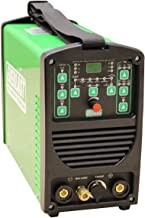
Everlast POWERARC 200ST 200AMP TIG Stick IGBT Welder 4.0 /5 Stars
AMICO TIG 160 Amp Torch ARC STick DC Welder 110/230V Dual Voltage Welding Machine 4.5 / 5 Stars
TIG Welder, DC, Maxstar 150 STL 5.0/5 Stars
AHP AlphaTIG 200X 4.6/5 Stars
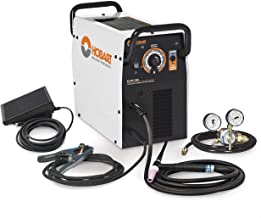
Hobart 500551 EZ-TIG 3.8/5 Stars
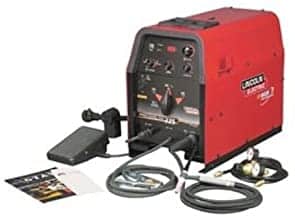
Lincoln Electric Precision TIG 225 K2535-2 4.0/5 Stars
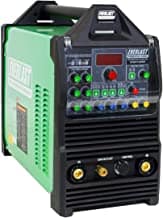
Everlast PowerTIG 250EX 3.5/5 Stars

What are the best cheap TIG welding machines?

Everlast POWERARC 200ST 200AMP TIG Stick IGBT Welder

For the price, this TIG welder is really all that you can ask for. The Everlast PowerARC is surprisingly lightweight when all of its capabilities are considered. Its lightweight design allows it to be incredibly portable and provide its owner with a fair amount of power. This is a great option for those individuals who are interested in both TIG and Stick welding. The fact that it has the capability to double as a stick welder is one of the reasons why it provides it users with such an immense level of value.

Aside from its ability to double as a stick welder it also features IGBT infineon modules, inverter technology as well as has a dual voltage capability. If you’re one of the people who worries about your machine breaking down before it’s supposed to worry no longer – Everlast gives every person who purchases this welder a 5-year warranty.

Pros

  • Doesn’t have a foot pedal but is lift start capable
  • Runs for 6-hour intervals
  • Functions as both a stick and TIG welder
  • Runs off of both 110 and 220 V

Cons

  • Doesn’t work as an AC welder
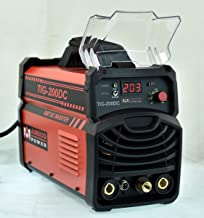
AMICO 200 AMP TIG Torch/ARC/Stick DC Inverter Welder Dual Voltage IGBT Welding

This and the previous model may seem very similar but, they have very distinct differences. This model features an onboard inverter as well as other, extra features that you typically don’t find with a welding machine such as: a work clamp, electrode holder, 13-foot cable. This dual voltage welder also works with both 110 and 230 V.

Typically, when you find a cheap welding machine you assume that the weld it produces will be subpar. The great thing about this machine is that it manages to produce clean, spatter free welds – welds that you sometimes don’t even find on the higher priced machines. This 200 Amp machine welds all types of materials, from steel, mild steel, copper, and stainless steel.

Pros

  • Gas line included
  • Lightweight
  • Portable design
  • Fully extendable

Cons

  • Isn’t flux core
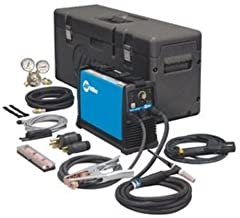
TIG Welder, DC, Maxstar 150 STL

The Maxstar 150 is designed to deliver awesome functionality in both the areas of performance and versatility. It can be used on a number of different metal types and can also be switched between both stick and TIG welding modes. Aside from those abilities, it’s also known for being incredibly portable (it weighs roughly 13.7 lbs and comes with a shoulder strap which makes it relatively simple to move around).

Aside from that it also has thermal overload protection, which means that it’s fans essentially reduce both it’s heat and power consumption. The Lift-Arch technology Miller included in this welder’s design also allows welders to work on both low and high frequencies without causing motor damage.

Let’s also not forget that this welder also has an open circuit voltage option which allows the welder to be run continuously and during specific times when necessary.

Pros 

  • It’s incredibly portable
  • It comes with a remote control which can adjust the welder from more than 5 feet away.
  • It’s easy for both beginner and advanced welders to use.
  • It gives you a choice of choosing the right voltage

Cons

  • When used at high outputs there may be power fluctuations
  • It doesn’t work well when used on thicker pieces of metal
  • It doesn’t come with all the power tools you may need
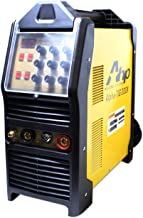
AHP AlphaTIG 200X

The AHP AlphaTIG 200X can be used for welding a number of metal types but works incredibly well on metals like Aluminum and Stainless Steel. This welding machine can be used to produce precise, thin welds on various metal types and can weld Aluminum up to 1/4″ thick and Steel up to 3/8″ thick.

Pros

  • It has advanced inverter technology
  • There are both 2T and 4T modes
  • You can use it right out of the box
  • It has adjustable output frequency
  • It offer excellent arc quality

Cons

  • It has has fans that tend to make quite a bit of noise
Hobart 500551 EZ-TIG

The Hobart 500551 EZ-TIG comes with an easy-to-use interface (hence the name EZ-TIG). All you need to do is power the welder up and select the material you want to use the welder on. It also has a Fan-On-Demand function which allows one to run the fan once it’s needed, which allows you reduce debris and the dust it draws in.

Aside from that, it also has the ability to weld 22 gauge up to 3/16″ thick as well as the ability to switch between DC and AC. It also has the ability to eliminate tungsten and other material contamination through it’s HF start to permit non-contact arc start.

Pros

  • It has an easy-to-use interface
  • It has a high temperature shutdown function
  • To allow for more consistent welds it has infinite amperage control
  • It has auto-postflow which allows for optimum shielding based on the welding amperage without requiring adjustment or waste.
  • One can switch between AC and DC power sources

Cons

Lincoln Electric Precision TIG 225 K2535-2

The Lincoln Electric Precision TIG is a more expensive TIG welder. It is incredibly efficient and is actually designed to deliver enhanced performance. Aside from that the Lincoln Electric Precision TIG welder can switch between both TIG welding and stick welding modes. It also features MicroStar Technology which allows the welder to deliver a low amp start as well as stability during the welding session.

The Lincoln Electric Precision TIG 225 K2535-2 also features an AC auto balance function which allows it to provide higher levels of penetration and cleaning.

Pros

  • It can complete a duty cycle at low voltage
  • It can be adjusted for any situation with penetration, cleaning, and pulse modes
  • Easy to customize design
  • It has an easy to use interface
  • F.A.N. reduces power consumption noise, motor wear, prevents overheating.

Cons

  • It’s a relatively expensive machine
Everlast PowerTIG 250EX

The Everlast PowerTIG comes with a five-amp start for DC and AC low amp operation. This welding machine is incredibly lightweight and portable while also having the ability to be used in a number of welding settings. It has settings that can be adjusted for 2t / 4t operation. Aside from that the Everlast PowerTIG 250EX also features high pulse frequency capability which helps reduce overall heat input and prevent burning or warpage from occurring.

The Everlast PowerTIG also features a 240V receptacle that’s built in and specifically designed for utilization with the Everlast PowerCool 300 water cooler.

Pros

Cons

  • This welder isn’t designed to weld thicker metals

How do you choose your first TIG Welder?

Video credits to Miller Welds. It discusses how to buy your first TIG welder.

Who says you have to spend thousands of dollars to get a high-quality machine. The machines on this list will likely fulfill all of your welding needs – unless you require a foot pedal or some other higher end welding capability.

Best Welding Wire for Mild Steel in 2023 – Reviews and Buyers Guide

A typical question that we get when it comes to welding mild steel is whether or not it can actually be welded. The short answer to that question would have to be, yes. It can be welded.

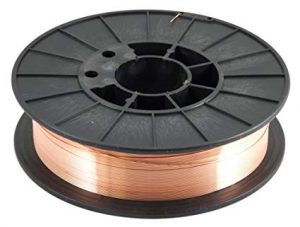
There are 2 basic types of wire that one can use to weld mild steel. On the one hand, we have ER70S – 3, an AWS classification. This type of wire is mainly used for all-purpose welding. The thickness of the welding wire that you decide to use will really depend on the type of material that you’re welding. A good, kind of neutral material to use would likely be a .03-inch diameter wire – it would be great for welding metals of a wide range of thickness and purpose.

Below are the welding wires to be reviewed

Welding Wire Reviews

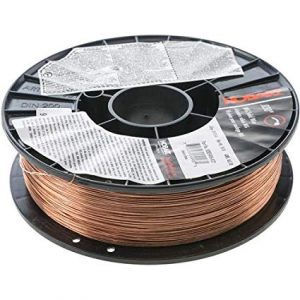
Hobart ER70S-6 Mild Steel MIG Welding Wire

  • Wire Diameter size 0.023 or 0.030 or 0.035 inch
  • Weight Available in 2 lb. spool or 10 lb. spool
  • Shielding Gas: 80% Argon 20% CO2 or can be used with C25 or 100% CO2 shielding gas
  • Welding Positions: An all position wire that supports single and multi pass welding
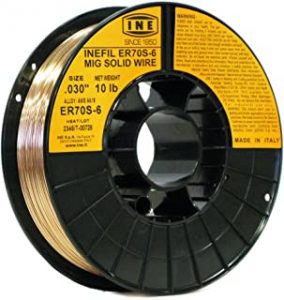
INEFIL ER70S-6 Mild Steel MIG Welding Wire

  • Wire Diameter size 0.024 or 0.030 or 0.035
  • Available sizes: 2 and 10 lb spool
  • Shielding Gas: C25, or 100% CO2
  • Welding Positions: An all position wire that supports single or multi pass
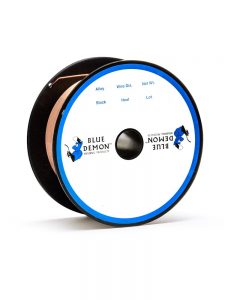
Blue Demon ER70S6 Mild Steel MIG Welding Wire

  • Wire Diameter Sizes: 0.023, 0.030, 0.035
  • Weight Available: 2lb spool or 11 lb. spool
  • Although the spool size says 11 lb. it will fit in a welder that can take 10 lb. spools. Check spool diameters size.
  • Shielding Gas: C25,
  • Welding Positions: F, V, OH H – Flat, Vertical, Overhead, Horizontal
Forney ER70S-6 Mild Steel MIG Welding Wire

  • Wire Diameter Sizes: 0.024 or 0.030 or 0.035
  • Weight Available: 2 lb. spool or 10 lb. spool
  • Shielding Gas: C25 or 100% CO2
  • Welding Positions: an all position wire that supports single and multi pass welding
How do you know if you’re welding mild steel?

For all intents and purposes mild steel can simply be regarded as steel with a very low amount of carbon in it’s makeup. It’s a very simple material to form and is also very common when it comes to MIG welding.

How do you choose a brand for welding wire?

The first thing to make sure of when you first start even considering purchasing welding wire is the quality that you want. If you want a high quality welding wire then you will likely require wire that meets the AWS standard for welding wire.

The AWS standard requires that wires meet a certain level of thickness and have a certain degree of tensile strength.

Where do you store welding wire?

Again, if you think it’s a good idea to buy welding wire then you likely understand that you will need a place to store it.

The most important thing to keep in mind when you’re looking for a place to store your welding wire is that it’s protected from the harmful material in the atmosphere. Keep your wire out of damp environments as this will cause it to oxidize and likely be rendered unusable over time.

The reason that you want to make sure your wire is protected is because it will likely not be possible for it to work correctly if it’s faulty and installed back into your welder. Faulty or rusted wire will likely lead to welding failure in the future.

How do you choose the right size for your welding wire?

There are really only 3 things that you want to make sure you pay attention to when sizing your wire.

  1. You want to pay attention to is the size welding wire that your machine can take.
  2. You want to make sure the wire is the right wire for your machine. Don’t buy flux core wire if you’re using a MIG welder.
  3. Make sure that the wire you use has a thickness that is proportionate to the material that you’ll be welding. If you’re welding a thinner metal, then you likely want to make sure that you use a thinner wire. Vis Versa for thicker metals.

Video credits to D.I.Y. Auto School. It talks about choosing a wire for MIG Welding. 

Best Welding Helmets of 2023 – Reviews & Buyer Guide

A few decades ago someone had the genius idea to create welding helmets that shielded the user’s eyes from the bright and somewhat harmful flares of light, and slag that appears during most types of welding activities. The initial welding mask featured an LCD shutter that would immediately darken when it detected the bright light of the welding arc. The introduction of this filter into the design of the mask reduced both welding time and the level of risk that the welder takes on when they decide that it’s time to begin welding. The great thing about the introduction of this auto-darkening welding helmet technology is that it gave others something to build upon. Innovative geniuses (much like the one who developed this helmet) decided that it would be a great idea to build upon the initial design of the auto-darkening helmet and create designs of their own.

This is where we come in. Great designs for auto-darkening helmets are being put out everyday. In our effort to make sure that you are aware of the best (and sometimes worse) designs we have decided to put together a holistic review based entirely on auto darkening welding helmets. This review does more than simple go over the features that make up a good auto darkening welding helmet; it talks about the  history of the helmet design, features included, and the way to use the helmet. Read on to find the reviews.

Below are the welders we review

Product Name Customer Reviews Editor Rating Uses
Hobart 770753
4.7 /5 Stars MIG, Stick, ARC, low amp TIG
Miller 251292
4.6 / 5 Stars MIG, Stick, ARC
Jackson Safety BH3
Jackson Safety BH3 reviews
4.6 /5 Stars Stick, MIG, TIG, ARC
Lincoln Electric 3350
4.6 / 5 Stars Stick, ARC, MIG, TIG
3M Speedglas 9100
4.5 /5 Stars Stick, MIG, TIG, ARC
Antra AH6-260-0000
Antra AH6-260-0000 reviews
4.4 / 5 Stars MIG, MAG, TIG, SMAW and Plasma Arc

What criteria do we use to rate welding helmets?

Switching time

Since the helmets are auto-darkening I’m sure that you would like to know how quickly the material in the helmet can switch between being light and dark. (I’m sure you wouldn’t want to wait for hours for the material to lighten back up after going dark initially.) What does switching time mean? It’s simply the time a helmet takes to transition from natural light to the darkened shade used when the torch is lit up. A fast switching speed should be desired over a slow one. A fast switching welding helmet will provide you with the least amount of exposure to the UV and infrared rays that result from your welding arc. Professional helmet lenses can darken at the speed of 1 / 16,000 of a second, while entry-level helmets typically have a switching speed of 1 / 3,600 of a second and up. As you get to a fast switching speed you generally see the price go up alongside it.

Heaviness of helmet

Light helmet = less body stress = more efficient work. You want to reduce stress and reduce pressure. A light helmet will reduce head, neck, and body stress thus reducing fatigue allowing you to work more efficiently and for a longer duration. Stress on the body can cause frequent breaks, dehydration, muscle tightening, etc. Aim for a goal of purchasing an auto darkening helmet with a weight of at most 10 pounds. Most of our recommended helmets are below that, so you should be okay.

Viewing size

Viewing size refers to the helmet viewing area that you look through when conducting welding jobs. Typically you will find a welding helmet view size of 5 square inches up to 10 square inches. It is typically recommended for professional welders to get a larger view port, while hobbyists get smaller ones simply to keep their budget in mind. Your view port will determine how easy it is for you to see while working, smaller viewing size helmets tend to be more difficult (I know, stating the obvious right?).

ANSI approval

National safety standards exist for welders and there are certain codes your equipment should be equal with. Don’t be a cheapskate and purchase a piece of equipment that introduces you to more long-term health risk. ANSI Z87.1 – 2003 is the newest safety standard for welders. Follow it, know it, and respect it. It has set a mandate that auto-darkening lens manufacturers will need to confirm their claimed specs (transition speed, dark shade settings, etc) with lab tests that are available to the consumer.

Number of sensors

Absolutely invest in a helmet that has a good number of sensors. Why? You ask? The number of sensors is directly related to the speed and amount of protection you have in case of spark or flame. You want to aim for 4 sensors to have on your welder helmet, but two will work (although not preferred). To reduce potential exposure, if you are a welder that frequently works on your back or side, go with the 4 sensors. If you traditionally work in a normal position you are exposed to less risk and can thus explore going with 2 sensor helmets.

[thrive_text_block color=”red” headline=”Things to keep in mind when choosing your welding helmet”] [/thrive_text_block]

Firstly, you need to realize that every individual has a different preference towards the specifications of their helmet such as weight, sensitivity, etc. Ultimately, you want the perfect balance between safety, comfort, and results. Once you understand that not every individual wears the same type of helmet, you’ll be well on your way to finding the best welding helmet for you.

  •  When deciding on what welding helmet is best for you, one absolutely crucial part is the amount of protection being provided to your face. You certainly need your full face covered no questions asked, and you need a helmet made out of material that is capable of shedding any molten fragment material.
  • A well-dimensioned viewing area through your welding mask is extremely important. Generally, welders look for semi-long periods of time, so a small viewing port will be difficult to work with. A small viewing area may result in having to position your head or back in poor ways resulting in posture issues, unnecessary body strain, or flipping up the helmet frequently which slows down the speed of your work.
  • Location of helmet controls is also another important thing that is often overlooked. Why’s this important? Well, let’s consider that if the controls are internal controls, you’re going to need to likely remove your helmet in order to make adjustments. This slows down your work and can become annoying quite quickly. External controls are nice, but they too have their flaws in that they can be damaged by airborne debris.

Welding Helmet Reviews

Antra AH6-260-0000

Antra AH6-260-0000

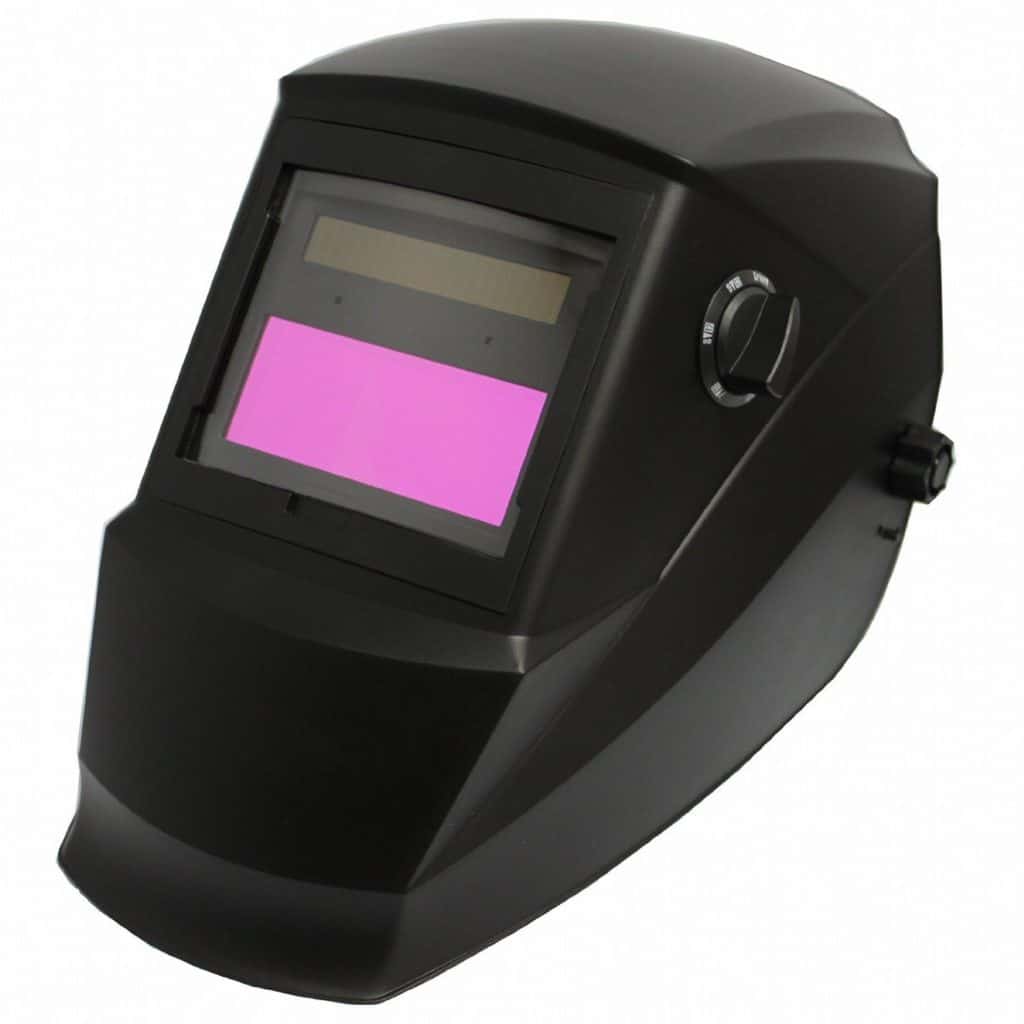
At the time of writing this review, the Antra AH6-260 is rated over 4.5 stars by our editor. It comes with an auto shut off/on functionality that is fully automatic. A unique feature to this helmet is the fact that it comes with an adjustable darkness setting that you can tailor to your own needs.

Not only does the Antra AH6-260 work for welding, but it’s also versatile enough to withstand plasma cutting work.  Measuring 9 x 8 x 12 with a weight of approximately 16 ounces (1 pound), it’s batteries included and capable of functioning with Plasma, Grinding, TIG, MIG, and ARC welding. Viewing specs of 3.86 x 1.78 inches and a variable shade inclusion of 4/5 – 9/9 – 13. While the price of the Antra AH6 may be somewhat low, it is by no means a “cheap welding helmet”.


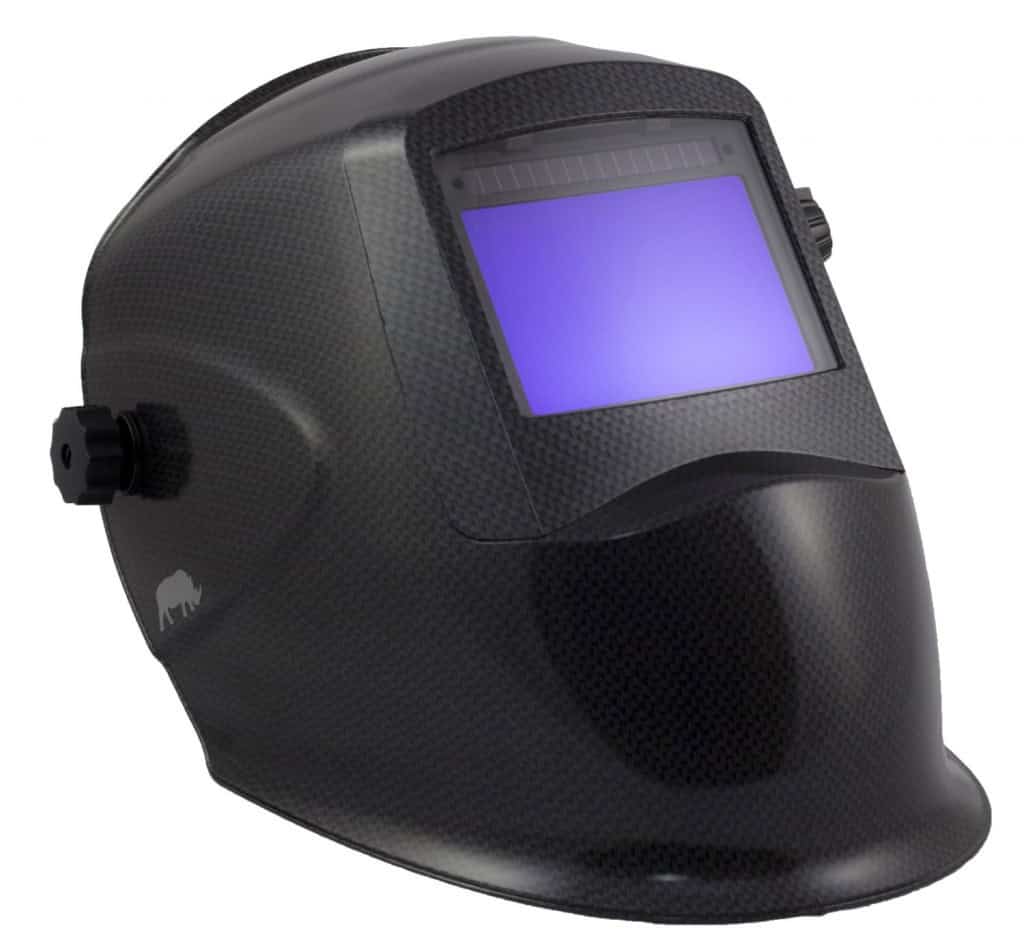
Rhino RH01

Rhino-RH01-Large-View-Carbon-Fiber-Auto-darkening-Helmet

Weighing in at roughly 1 lbs 2 ounces the Rhino RH01 works great for SMAW, GMAW, PAC, FCAW, GTAW, and PAW welding. It features a switching speed of 1/25,000 of a second and is made of lightweight nylon shell. The RH01 is also known as the Rhino Large View + Grind Auto Darkening Helmet and features a massive 10 square inch viewing area. The headband has been known to loosen up at times, however, it also comes with a ratchet style headgear to aid in support. Replacement parts are extremely easy to find making this a popular addition to any welders equipment stock. Ah, one last thing – it’s also solar powered and features 2 arc sensors!


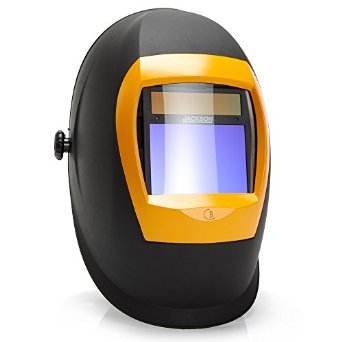
Jackson Safety W70 BH3

Jackson-Safety-W70-bh3
The W70 BH3 is among the most expensive helmet you’ll find on our list today, but it stands out amongst the competition in terms of clarity and light diffusion. Essentially, you get what you pay for with this particular product. Featuring an auto-on filter designed for auto darkening, it weighs in at roughly 2.1 lbs and provides superb protection for MIG, TIG, and ARC welding scenarios. A switching speed of 0.15 microseconds makes it extremely fast! Dimensions measure at 12 and a quarter inch x 9 and five-eighths x 9 and three-quarters inches with an EN379 rating of 1/1/1/1. That is fantastic, I am particularly fond of the viewing port on this helmet which helps aid in preparation ease and speed.


3M Speedglas 9100

If you’re looking to step your game up and weld like the pros the 3M Speedglas 9100 is probably the best bet for you. This welding helmet comes with a bundle of features such as the 3 sensors, Auto shut off capabilities, dual lenses, side shields. The switch speed of the Speedglas 9100 ranges from 40 to 800 ms, making it a decent choice by all welders standards. Another plus of this helmet is that it weighs in at only 20.2 oz, which reduces the fatigue you feel after a long day of using it. The feature I found to be the most useful is the solar-assisted sensor. This aspect basically saves both the battery life (reducing the effect on your pockets) and aids in switching speed.


Lincoln Electric 3350

Best Welding Helmets of 2018 - Reviews & Buyer Guide

Weighing in at 20 oz the Lincoln Electric 3350 is the best welding helmet for those who require something that’s both easy on the pockets and the neck. The Lincoln Electric 3350 features internal shade controls as well as 3 different sensitivity controls: variable shade, delay, light sensitivity. The viewing screen on this helmet measures at 3.74 in x 3.34 in. Considering the low price, the features included are kind of over-justified. For instance, I’ve rarely ever seen a model in this price range include 3 different sensitivity types nor this many sensors.
Of course, every decent product must have its downsides as well. The Lincoln Electric 3350’s lenses have a tendency to get scratched easily if cleaned with a rough material – make sure to clean it with a thin and porous nature such as linen.


Miller 251292

miller 251292 reviews

Considering that it’s one of the least expensive welding helmets on this guide, the Miller 251292 kind of surprised me. First off, it has 2 sensors, which isn’t really that outstanding considering that there are helmets on this guide with 3+ sensors. It has variable shade and light state sensitivity of #8-13 and light state #3. The view area on the Miller 251292 is 3.70 x 1.37 in and it weighs in at about 16 oz. While the viewing area may not be the largest you’ll see on a helmet, the associated weight more than makes up for it. In addition to it’s lightweight, the Miller 251292 meets high impact ANSI standards.


Hobart 770753

hobart 770753 reviews

Last but not least we have the Hobart 770753. This helmet somehow manages to fall right in the middle when it comes to price and much like the previously mentioned helmet has features that make the low price stand out. This helmet features a Grind mode as well as an Auto shut off feature. It’s also approved by the ANSI which basically means that you will be receiving an item that has been tested for its ability to actually provide you with protection during a weld. The switch delay on the Hobart 770753 is between .1 and 1 seconds depending on the settings. The best thing about this particular helmet are it’s sensitivity controls and its ability to adjust to a multitude of light conditions.


How do you use a welding helmet

Video credits to MrAdkinsAuto. It discusses how to use a welding helmet.

Welding Helmet Common Questions

What is a passive style welding helmet?

Let’s start off by saying, that generally speaking a passive welding hood isn’t something we would suggest for a beginner welder. However, most experienced welders will generally have no problem using them.  In general, we recommend not to use these for beginners because they will have trouble seeing the electrode part of the torch (yeah, you learn with experience).

About the only benefit to a passive welding mask is that they are cheap and affordable, however to us the risk of injuries and difficulty for a newbie just isn’t worth it.

What is a filter lens for a welding helmet?

A filter lens is the part of a welding helmet used to protect the welder’s eyes. They are a crucial part of a helmet because they’re responsible for protecting your eyes from the UV and infrared light exposure. We call these key non-impact dangers that a welder is susceptible to.

How long do most auto-darkening welding helmets last?

There is no exact length of time. However, factors that can influence helmet lifetime include, but are not limited to:

  • The quality used for the helmet material
  • How well you take care of the helmet
  • How often you use the helmet
How much should I expect to spend on my welding helmet?

We suggest at least $100 USD (as it wouldn’t be the best thing to get a cheap welding helmet), but here’s a better perspective on the price tiers you can expect.

  • $0 – $100 beginner helmets
  • $100 – $200 decent helmets
  • $200 -$300 good helmets
  • $300 + exceptional helmets
Are mask, hood, and helmet all synonyms for welding helmets? Are there any other common synonyms?

Yes, when you see any of these referenced in regards to welding they are all referring to the same thing. It’s confusing, but it’s something you should just become used to.


What’s the purpose of a welding helmet?

Arc Eye & Retina Burn Protection

Welding helmets are headgear utilized to perform different types of welding and to protect eyes, neck, and face from flash burn, sparks, UV light, heat, and infrared light. Ultraviolet emissions produced from welding arc can cause damages to exposed skin as well as eyes; hence, workers use helmets with filters called lens shades. Radiation, splashes, and gasses are hazardous to skin and eyes hence helmets are designed to protect welders from exposure to these hazards.

They are used to prevent retina burns and arc eye which are caused by too much exposure to the sparks. They are usually used with arc welding processes such as gas tungsten welding, shielded metal welding, and gas metal welding. A decent welding helmet is crucial for welders and apart from the additional safety precautions, a helmet could help with overall welding performance. Welding helmets are available in a variety of optical densities particularly designed to filter the light intensity produced by the arc.


What’s the history of welding helmets?

The Evolution Of Welding Helmets

Welding can be traced back to the ancient times as early as the Bronze Age. During this age, small gold boxes were used and are estimated that these gold boxes were made more than 2000 years ago. The Egyptians and the eastern Mediterranean people learned the art of welding iron pieces together during the Iron Age. Further, the art of blacksmithing became popular during the middle ages and iron items were produced by hammering. Welding has been done since the Bronze Age, however, using of welding helmets came only in 1905.

Frederick M. Bowers was the man who invented the first welding helmets. He got the inspiration to make welding helmets when he saw that welders in his hometown needed improved protection while working in ships, pipelines, and railroads. He founded the Fibre-Metal Products Company and manufactured the first ever welding helmet in 1905. Later, the company pioneered in the production of face shields, fiber metal caps, and goggles. Industrial Revolution demanded more welders in the 1930s; therefore, welders used face masks and goggles to protect themselves. However, the proper use of welding helmets started only in the year 1937.

The early helmets were simple with a polarized lens or dark tinted glass without UV radiation filter. During the First World War, the high demand for weapons production pressured companies to manufacture electrodes and welding machines. This may have further influenced for the establishment of new welding helmet manufacturers. Later, welding helmets kept developing with better technologies and the first auto darkening helmet was introduced. In the 1940s the most recent type of welding helmet was introduced and since then it has evolved significantly.

In 1981, Swedish manufacturing company Hornell created the first auto darkening welding helmets under the brand name Speedglas.

In 2004, the company Hornell was taken over by another welding helmet company called 3M. In addition, Frederick M. Bower’s company Fibre-Metal Products Company was sold to North Safety Products in the year 2005. Today, both companies manufacture and sell standard helmets as well as auto-darkening helmets. 3M Company was previously known as the Minnesota Mining and Manufacturing Company. Today, it operates in more than 67 countries across the globe. Some of the best-renowned welding helmet manufacturers today are the Miller Electric, Lincoln Electric, 3M, Jackson, and Hobart.

What are the types of welding hoods? 

Standard or Passive Welding Helmets

This type of welding helmet is made of molded plastics and is coated with infrared lights. The shield is durable and its extended front protects users from physical hazards. One can clearly view various angles and is also provided with adjustable sensitivity. They are popular for being cheaper than auto-darkening welding helmets. Generally, they come with a 10 lens shade that does not change whether a welder is welding or not. They give effective protection and is easy to put and easy to take off as well.

Auto-darkening Welding Helmets

Auto-darkening welding helmets are lightweight and designed to minimize neck discomfort. When a welder strikes the arc, these helmets automatically darken and many injuries have been reduced by Auto-darkening helmets. They are proved to be especially useful for modern welders working under poor light conditions. It comes in three different types, the fixed lens shade, professional and intermediate, and battery and solar powered. These helmets are designed to have light sensors present near the lens that helps welders in viewing like sun-glass shade.

The sensors are utilized in order to get better coverage. This type of welding helmets is known to be the best ones which also provide clear vision. In the professional and intermediate helmet, the amount of brightness depends on the intensity of the lens. The brightness will be dimmer if the intensity is lower. Battery helmets are rechargeable as it is made of lithium and it can be charged in the sunlight because of the solar panels. The solar panel supplies backup power if the battery suffers low power. Solar power helmets are known to be most useful while working outside and battery-powered helmets for underground or inside large structures. Both utilize the sensors in order to identify when the light brightens, and when it is time to adjust the glass in the face shield to block only the right amount of light.

Auto-darkening helmets basic models develop darker shade with any contact to arc light no matter where the light comes from. Auto-darkening deluxe model helmets have special sensors that can detect the difference between a co-workers arc and operator’s arc. The advantage of an auto-darkening welding helmet is that it allows the welder to accurately see the area that needs to be welded.

The lenses are available in glass as well as plastic, and glass lenses are said to be better for not containing color distortions. It is known that a conventional welding helmet can blind a welder if the welder is too abruptly welding and killing the arc, leaving the welder in total darkness and vulnerable to fall or harm. This is why many construction companies at present require welders to use auto-darkening helmets.

Best Welding Helmets of 2019 – Reviews & Buyer Guide

A few decades ago someone had the genius idea to create welding helmets that shielded the user’s eyes from the bright and somewhat harmful flares of light, and slag that appears during most types of welding activities. The initial welding mask featured an LCD shutter that would immediately darken when it detected the bright light of the welding arc. The introduction of this filter into the design of the mask reduced both welding time and the level of risk that the welder takes on when they decide that it’s time to begin welding. The great thing about the introduction of this auto-darkening welding helmet technology is that it gave others something to build upon. Innovative geniuses (much like the one who developed this helmet) decided that it would be a great idea to build upon the initial design of the auto-darkening helmet and create designs of their own.
This is where we come in. Great designs for auto-darkening helmets are being put out everyday. In our effort to make sure that you are aware of the best (and sometimes worse) designs we have decided to put together a holistic review based entirely on auto darkening welding helmets. This review does more than simple go over the features that make up a good auto darkening welding helmet; it talks about the  history of the helmet design, features included, and the way to use the helmet. Read on to find the reviews.
Below are the welders we review

Product Name Customer Reviews Editor Rating Uses
Hobart 770753
4.7 /5 Stars MIG, Stick, ARC, low amp TIG
Miller 251292
4.6 / 5 Stars MIG, Stick, ARC
Jackson Safety BH3
Jackson Safety BH3 reviews
4.6 /5 Stars Stick, MIG, TIG, ARC
Lincoln Electric 3350
4.6 / 5 Stars Stick, ARC, MIG, TIG
3M Speedglas 9100
4.5 /5 Stars Stick, MIG, TIG, ARC
Antra AH6-260-0000
Antra AH6-260-0000 reviews
4.4 / 5 Stars MIG, MAG, TIG, SMAW and Plasma Arc

What criteria do we use to rate welding helmets?

Switching time

Since the helmets are auto-darkening I’m sure that you would like to know how quickly the material in the helmet can switch between being light and dark. (I’m sure you wouldn’t want to wait for hours for the material to lighten back up after going dark initially.) What does switching time mean? It’s simply the time a helmet takes to transition from natural light to the darkened shade used when the torch is lit up. A fast switching speed should be desired over a slow one. A fast switching welding helmet will provide you with the least amount of exposure to the UV and infrared rays that result from your welding arc. Professional helmet lenses can darken at the speed of 1 / 16,000 of a second, while entry-level helmets typically have a switching speed of 1 / 3,600 of a second and up. As you get to a fast switching speed you generally see the price go up alongside it.

Heaviness of helmet

Light helmet = less body stress = more efficient work. You want to reduce stress and reduce pressure. A light helmet will reduce head, neck, and body stress thus reducing fatigue allowing you to work more efficiently and for a longer duration. Stress on the body can cause frequent breaks, dehydration, muscle tightening, etc. Aim for a goal of purchasing an auto darkening helmet with a weight of at most 10 pounds. Most of our recommended helmets are below that, so you should be okay.

Viewing size

Viewing size refers to the helmet viewing area that you look through when conducting welding jobs. Typically you will find a welding helmet view size of 5 square inches up to 10 square inches. It is typically recommended for professional welders to get a larger view port, while hobbyists get smaller ones simply to keep their budget in mind. Your view port will determine how easy it is for you to see while working, smaller viewing size helmets tend to be more difficult (I know, stating the obvious right?).

ANSI approval

National safety standards exist for welders and there are certain codes your equipment should be equal with. Don’t be a cheapskate and purchase a piece of equipment that introduces you to more long-term health risk. ANSI Z87.1 – 2003 is the newest safety standard for welders. Follow it, know it, and respect it. It has set a mandate that auto-darkening lens manufacturers will need to confirm their claimed specs (transition speed, dark shade settings, etc) with lab tests that are available to the consumer.

Number of sensors

Absolutely invest in a helmet that has a good number of sensors. Why? You ask? The number of sensors is directly related to the speed and amount of protection you have in case of spark or flame. You want to aim for 4 sensors to have on your welder helmet, but two will work (although not preferred). To reduce potential exposure, if you are a welder that frequently works on your back or side, go with the 4 sensors. If you traditionally work in a normal position you are exposed to less risk and can thus explore going with 2 sensor helmets.

[thrive_text_block color=”red” headline=”Things to keep in mind when choosing your welding helmet”] [/thrive_text_block]

Firstly, you need to realize that every individual has a different preference towards the specifications of their helmet such as weight, sensitivity, etc. Ultimately, you want the perfect balance between safety, comfort, and results. Once you understand that not every individual wears the same type of helmet, you’ll be well on your way to finding the best welding helmet for you.

  •  When deciding on what welding helmet is best for you, one absolutely crucial part is the amount of protection being provided to your face. You certainly need your full face covered no questions asked, and you need a helmet made out of material that is capable of shedding any molten fragment material.
  • A well-dimensioned viewing area through your welding mask is extremely important. Generally, welders look for semi-long periods of time, so a small viewing port will be difficult to work with. A small viewing area may result in having to position your head or back in poor ways resulting in posture issues, unnecessary body strain, or flipping up the helmet frequently which slows down the speed of your work.
  • Location of helmet controls is also another important thing that is often overlooked. Why’s this important? Well, let’s consider that if the controls are internal controls, you’re going to need to likely remove your helmet in order to make adjustments. This slows down your work and can become annoying quite quickly. External controls are nice, but they too have their flaws in that they can be damaged by airborne debris.

Welding Helmet Reviews

Antra AH6-260-0000

Best Welding Helmets of 2018 - Reviews & Buyer Guide
At the time of writing this review, the Antra AH6-260 is rated over 4.5 stars by our editor. It comes with an auto shut off/on functionality that is fully automatic. A unique feature to this helmet is the fact that it comes with an adjustable darkness setting that you can tailor to your own needs.
Not only does the Antra AH6-260 work for welding, but it’s also versatile enough to withstand plasma cutting work.  Measuring 9 x 8 x 12 with a weight of approximately 16 ounces (1 pound), it’s batteries included and capable of functioning with Plasma, Grinding, TIG, MIG, and ARC welding. Viewing specs of 3.86 x 1.78 inches and a variable shade inclusion of 4/5 – 9/9 – 13. While the price of the Antra AH6 may be somewhat low, it is by no means a “cheap welding helmet”.


Rhino RH01

Best Welding Helmets of 2018 - Reviews & Buyer Guide
Weighing in at roughly 1 lbs 2 ounces the Rhino RH01 works great for SMAW, GMAW, PAC, FCAW, GTAW, and PAW welding. It features a switching speed of 1/25,000 of a second and is made of lightweight nylon shell. The RH01 is also known as the Rhino Large View + Grind Auto Darkening Helmet and features a massive 10 square inch viewing area. The headband has been known to loosen up at times, however, it also comes with a ratchet style headgear to aid in support. Replacement parts are extremely easy to find making this a popular addition to any welders equipment stock. Ah, one last thing – it’s also solar powered and features 2 arc sensors!


Jackson Safety W70 BH3

Best Welding Helmets of 2018 - Reviews & Buyer Guide
The W70 BH3 is among the most expensive helmet you’ll find on our list today, but it stands out amongst the competition in terms of clarity and light diffusion. Essentially, you get what you pay for with this particular product. Featuring an auto-on filter designed for auto darkening, it weighs in at roughly 2.1 lbs and provides superb protection for MIG, TIG, and ARC welding scenarios. A switching speed of 0.15 microseconds makes it extremely fast! Dimensions measure at 12 and a quarter inch x 9 and five-eighths x 9 and three-quarters inches with an EN379 rating of 1/1/1/1. That is fantastic, I am particularly fond of the viewing port on this helmet which helps aid in preparation ease and speed.


3M Speedglas 9100

Best Welding Helmets of 2018 - Reviews & Buyer Guide
If you’re looking to step your game up and weld like the pros the 3M Speedglas 9100 is probably the best bet for you. This welding helmet comes with a bundle of features such as the 3 sensors, Auto shut off capabilities, dual lenses, side shields. The switch speed of the Speedglas 9100 ranges from 40 to 800 ms, making it a decent choice by all welders standards. Another plus of this helmet is that it weighs in at only 20.2 oz, which reduces the fatigue you feel after a long day of using it. The feature I found to be the most useful is the solar-assisted sensor. This aspect basically saves both the battery life (reducing the effect on your pockets) and aids in switching speed.


Lincoln Electric 3350

Best Welding Helmets of 2018 - Reviews & Buyer Guide
Weighing in at 20 oz the Lincoln Electric 3350 is the best welding helmet for those who require something that’s both easy on the pockets and the neck. The Lincoln Electric 3350 features internal shade controls as well as 3 different sensitivity controls: variable shade, delay, light sensitivity. The viewing screen on the this helmet measures at 3.74 in x 3.34 in. Considering the low price the features included are kind of over-justified, For instance, I’ve rarely ever seen a model in this price range include 3 different sensitivity types nor this many sensors.
Of course, every decent product must have its downsides as well. The Lincoln Electric 3350’s lenses have a tendency to get scratched easily if cleaned with a rough material – make sure to clean it with a thin and porous nature such as linen.


Miller 251292

Best Welding Helmets of 2018 - Reviews & Buyer Guide
Considering that it’s one of the least expensive welding helmets on this guide, the Miller 251292 kind of surprised me. First off, it has 2 sensors, which isn’t really that outstanding considering that there are helmets on this guide with 3+ sensors. It has variable shade and light state sensitivity of #8-13 and light state #3. The view area on the Miller 251292 is 3.70 x 1.37 in and it weighs in at about 16 oz. While the viewing area may not be the largest you’ll see on a helmet, the associated weight more than makes up for it. In addition to it’s lightweight, the Miller 251292 meets high impact ANSI standards.


Hobart 770753

hobart 770753 reviews
Last but not least we have the Hobart 770753. This helmet somehow manages to fall right in the middle when it comes to price and much like the previously mentioned helmet has features that make the low price stand out. This helmet features a Grind mode as well as an Auto shut off feature. It’s also approved by the ANSI which basically means that you will be receiving an item that has been tested for its ability to actually provide you with protection during a weld. The switch delay on the Hobart 770753 is between .1 and 1 seconds depending on the settings. The best thing about this particular helmet are it’s sensitivity controls and its ability to adjust to a multitude of light conditions.


How do you use a welding helmet
https://www.youtube.com/watch?v=ZUPYBOMWidg
Video credits to ChuckE2009. It discusses how to use a welding helmet.

Welding Helmet Common Questions

What is a passive style welding helmet?

Let’s start off by saying, that generally speaking a passive welding hood isn’t something we would suggest for a beginner welder. However, most experienced welders will generally have no problem using them.  In general, we recommend not to use these for beginners because they will have trouble seeing the electrode part of the torch (yeah, you learn with experience).
About the only benefit to a passive welding mask is that they are cheap and affordable, however to us the risk of injuries and difficulty for a newbie just isn’t worth it.

What is a filter lens for a welding helmet?

A filter lens is the part of a welding helmet used to protect the welder’s eyes. They are a crucial part of a helmet because they’re responsible for protecting your eyes from the UV and infrared light exposure. We call these key non-impact dangers that a welder is susceptible to.

How long do most auto-darkening welding helmets last?

There is no exact length of time. However, factors that can influence helmet lifetime include, but are not limited to:

  • The quality used for the helmet material
  • How well you take care of the helmet
  • How often you use the helmet
How much should I expect to spend on my welding helmet?

We suggest at least $100 USD (as it wouldn’t be the best thing to get a cheap welding helmet), but here’s a better perspective on the price tiers you can expect.

  • $0 – $100 beginner helmets
  • $100 – $200 decent helmets
  • $200 -$300 good helmets
  • $300 + exceptional helmets
Are mask, hood, and helmet all synonyms for welding helmets? Are there any other common synonyms?

Yes, when you see any of these referenced in regards to welding they are all referring to the same thing. It’s confusing, but it’s something you should just become used to.


What’s the purpose of a welding helmet?

Arc Eye & Retina Burn Protection

Welding helmets are headgear utilized to perform different types of welding and to protect eyes, neck, and face from flash burn, sparks, UV light, heat, and infrared light. Ultraviolet emissions produced from welding arc can cause damages to exposed skin as well as eyes; hence, workers use helmets with filters called lens shades. Radiation, splashes, and gasses are hazardous to skin and eyes hence helmets are designed to protect welders from exposure to these hazards.
They are used to prevent retina burns and arc eye which are caused by too much exposure to the sparks. They are usually used with arc welding processes such as gas tungsten welding, shielded metal welding, and gas metal welding. A decent welding helmet is crucial for welders and apart from the additional safety precautions, a helmet could help with overall welding performance. Welding helmets are available in a variety of optical densities particularly designed to filter the light intensity produced by the arc.


What’s the history of welding helmets?

The Evolution Of Welding Helmets

Welding can be traced back to the ancient times as early as the Bronze Age. During this age, small gold boxes were used and are estimated that these gold boxes were made more than 2000 years ago. The Egyptians and the eastern Mediterranean people learned the art of welding iron pieces together during the Iron Age. Further, the art of blacksmithing became popular during the middle ages and iron items were produced by hammering. Welding has been done since the Bronze Age, however, using of welding helmets came only in 1905.
Frederick M. Bowers was the man who invented the first welding helmets. He got the inspiration to make welding helmets when he saw that welders in his hometown needed improved protection while working in ships, pipelines, and railroads. He founded the Fibre-Metal Products Company and manufactured the first ever welding helmet in 1905. Later, the company pioneered in the production of face shields, fiber metal caps, and goggles. Industrial Revolution demanded more welders in the 1930s; therefore, welders used face masks and goggles to protect themselves. However, the proper use of welding helmets started only in the year 1937.
The early helmets were simple with a polarized lens or dark tinted glass without UV radiation filter. During the First World War, the high demand for weapons production pressured companies to manufacture electrodes and welding machines. This may have further influenced for the establishment of new welding helmet manufacturers. Later, welding helmets kept developing with better technologies and the first auto darkening helmet was introduced. In the 1940s the most recent type of welding helmet was introduced and since then it has evolved significantly.
In 1981, Swedish manufacturing company Hornell created the first auto darkening welding helmets under the brand name Speedglas.
In 2004, the company Hornell was taken over by another welding helmet company called 3M. In addition, Frederick M. Bower’s company Fibre-Metal Products Company was sold to North Safety Products in the year 2005. Today, both companies manufacture and sell standard helmets as well as auto-darkening helmets. 3M Company was previously known as the Minnesota Mining and Manufacturing Company. Today, it operates in more than 67 countries across the globe. Some of the best-renowned welding helmet manufacturers today are the Miller Electric, Lincoln Electric, 3M, Jackson, and Hobart.

What are the types of welding hoods? 

Standard or Passive Welding Helmets

This type of welding helmet is made of molded plastics and is coated with infrared lights. The shield is durable and its extended front protects users from physical hazards. One can clearly view various angles and is also provided with adjustable sensitivity. They are popular for being cheaper than auto-darkening welding helmets. Generally, they come with a 10 lens shade that does not change whether a welder is welding or not. They give effective protection and is easy to put and easy to take off as well.

Auto-darkening Welding Helmets

Auto-darkening welding helmets are lightweight and designed to minimize neck discomfort. When a welder strikes the arc, these helmets automatically darken and many injuries have been reduced by Auto-darkening helmets. They are proved to be especially useful for modern welders working under poor light conditions. It comes in three different types, the fixed lens shade, professional and intermediate, and battery and solar powered. These helmets are designed to have light sensors present near the lens that helps welders in viewing like sun-glass shade.
The sensors are utilized in order to get better coverage. This type of welding helmets is known to be the best ones which also provide clear vision. In the professional and intermediate helmet, the amount of brightness depends on the intensity of the lens. The brightness will be dimmer if the intensity is lower. Battery helmets are rechargeable as it is made of lithium and it can be charged in the sunlight because of the solar panels. The solar panel supplies backup power if the battery suffers low power. Solar power helmets are known to be most useful while working outside and battery-powered helmets for underground or inside large structures. Both utilize the sensors in order to identify when the light brightens, and when it is time to adjust the glass in the face shield to block only the right amount of light.
Auto-darkening helmets basic models develop darker shade with any contact to arc light no matter where the light comes from. Auto-darkening deluxe model helmets have special sensors that can detect the difference between a co-workers arc and operator’s arc. The advantage of an auto-darkening welding helmet is that it allows the welder to accurately see the area that needs to be welded.
The lenses are available in glass as well as plastic, and glass lenses are said to be better for not containing color distortions. It is known that a conventional welding helmet can blind a welder if the welder is too abruptly welding and killing the arc, leaving the welder in total darkness and vulnerable to fall or harm. This is why many construction companies at present require welders to use auto-darkening helmets.

Best Welding Glasses 2023 – Reviews Inside

Welding is a dangerous profession that exposes welders to quite a bit of risk. Fortunately, there are pieces of welding equipment that exist to mitigate the risks – assuming you follow protocol. Having the best welding glasses possible will cause your welding career to be prolonged immensely.

The Center for Disease Control & Prevention (CDC)  states that roughly 200 US workers receive medical treatment every day due to eye-related injuries that occur on the job. This is why it’s essential for welders to wear proper eye protection that protects them from flying metal fragments, glare, heat, UV rays, etc.

Below are the welding glasses to be reviewed. 

How do you choose welding glasses or goggles?

There is nothing worse than thinking you did a good job of protecting yourself, only to find out you ended up with sub-par equipment. Our goal is to minimize the chance of that.

Top 3 Important Questions To Ask:

More details…

Sizing & Fit

You obviously need to make sure your eye protection is sturdy, comfortable, and fits around your head and eyes properly. Another very important thing to be aware of is that you should aim to purchase glasses with side protection (one reason welding goggles are popular over glasses).

Dangerous particles rarely come at you directly, instead, they float into the air and are pushed by wind or a breeze into your eye area from the peripheral side. Make sure you have side shields or wrap-around framed eyewear.

You also want to make sure that the fitting is not too tight around your head. This could create pressure and stress which in turn creates headaches and reduces your working efficiency and quality.

Impact Resistance

The American National Standards Institute z87.1-1989 states that clear polycarbonate lenses are the standard for industrial impact resistance. Essentially this means that your lenses can handle a shard of something flying off and hitting them and that they won’t weaken or crack due to it. This is all about keeping your eyes safe.

UV Protection

Welding gives off a very high volume of light that is capable of producing severe eye damage if you do not use proper protection. Welding also gives off potent UV rays, so make sure you purchase eye protection with proper shading and filters for the job. Auto-darkening welding glasses and goggles are becoming more and more popular specifically for this reason.

Dust Protection

Dust protection can potentially be remedied when ensuring a proper fit. Foam liners are a great way to protect from dust while still providing comfort.

Anti-Fog Coating

This is specifically key if you are in a high humidity area or a place where condensation can form. The welding safety glasses are typically labeled if they use this coating.


Welding Goggle Reviews

Each of these items will be checked for their ability to follow the guidelines listed above as well as for their overall functionality.


Miller Electric Shade 5.0 Welding Glasses

If you’re looking for an inexpensive option that will provide adequate protection for your eyes with ease, a possible purchasing option would likely be the Miller Electric Shade Glasses. These may look like basic welding goggles but, they have features that directly transfer over to the welding practice. Of these, a few very important ones to make note of would likely be the UV protection, Electric lens, and the polarized lens featured in the item.

As we all know, welding is an activity that exposes one to the harmful level of UV rays. These rays can deal an immense blow to one’s skin health and overall well-being if not properly checked. Let’s also not forget the fact that they can easily cause damage to one’s eyesight as well. This is where the ArcArmor UV protection comes in handy – it provides one with the coverage that one would need for their eyes to be fully protected which results in the individual prolonging the overall health of their eyes. Also, if scratching was an issue with your other glasses, or you simply don’t want to deal with the trouble of buying an item that will likely scratch up easily after being used for a period of time.

The price of the Miller Electric Shade 5.0 is reasonable – if not cheap. It can be found in various places for well under 50$; for a pair of welding glasses, this is a steal. These would be a great option if what you’re looking for are cheap welding glasses.


Jackson Safety V30 Nemesis Safety Glasses 

The Jackson Safety V30 Nemesis is a great option for an individual who likes to make sure that they have coverage in case anything happens. These glasses come in a pack of 12 which basically means that if something happens to a single pair, you have 11 more of them left over. The great thing about the high count of the item is that Jackson still made sure to place care into their production. They come with a standard mirror coating which aids in providing protection for the pupils and preserving one’s overall eye-health. Also, make note of the fact that they have a design that is up to the standards of the ANSI (American National Standards Institute).

For those price conscious individuals, the Jackson Safety V30 Nemesis Safety Goggles will definitely make sure to provide one with a level of value. A package of 12 of these glasses sells for just under 50$; meaning that each pair costs roughly 4.17$.


Servore Auto Shade Darkening Goggle Arc-513

The Servore Auto Shade Darkening Welding Goggles are chock-full of useful features. While they may not have the simplicity to be utilized in the way that one would like, they do have a design that allows them to be used in a wide variety of circumstances though. For instance, for those individuals who wear prescription glasses, the Servore Auto-Darkening glasses have a frame that can have prescription lenses fit into it. They may not have an auto-powering feature but, their design does have a power button included into it that can easily be switched on. Not to mention that they have auto-darkening features that can easily be utilized to their maximum potential with a quick perusal of their instructions.

These items have a price that is actually well-justified by the features included in the item itself. They can be found on various different sites as well as in various different stores for less than 160$.


Miller Electric Welding Goggles

This is definitely an item that “comes with it all”. It features a dual-lensed design made up of both an outer and inner lens. The outer lens provides UV protection as well as an extra layer for prevention against flying pieces of material from popping into one’s eyes. They also feature a full-facial covering that allows the item to provide one with a more protection from stray materials – something that isn’t afforded by more minimal welding covers. This protection is one of the things that qualifies these Miller Electric goggles as one of the best welding goggles on the market currently.

The glass ABS frame material also ensures that the item provides full-coverage for one’s facial features during the activity. The goggles also have an adjustability feature for sensitivity, which can be helpful for protecting more sensitive eyes from welding activities that give off violent light or radiant energy.

For the functionality, one should fully expect to pay a low price for an item that provides full facial coverage for welding activities. With that being said, for the features, the price range of below 180$ is definitely nowhere near where it should be listed – it has more value than that.


Welding Glasses & Goggles Wrap-Up

It isn’t always the easiest thing to find welding goggles/ glasses that effectively protect the eyes while also having functional qualities added to their design. Many of the goggles on this list have auto-dimming or visual coverage properties that basically allow the item to protect not only the outer area of the eye but the actual site of the user as well – this is incredibly helpful simply because of the fact that the eye is an essential tool for welding. It’s suggested that you view the items on this list as sort of basic to exceptional tools(starting from the bottom up).

Miller Dynasty 210 DX Review

The Miller Dynasty 210 DX is a quality made welder featuring Miller Electric’s exclusive advanced inverter technology with Auto-Line tech.

Miller Dynasty 210 DX Review

Some consider the Dynasty 210 DX to be the most flexible welder with regards to AC/DC, TIG/Stick power supply. Its maximum voltage is around 460 volts and contains SquareWave Arc designed to increase the welding capabilities for aluminum and magnesium welds.

The “DX” represents a mode that allows for an air-cooled fingertip controlled contractor kit. Meaning it offers pulsing capabilities, pulse frequency adjustments, a peak percentage time, and a variety of amperage, slope time, and control settings.

Pros of the Miller Dynasty 210 DX

  • Longer tungsten life due to a cleaning control setting
  • AC frequency control range of 20 – 250 kHz
  • Build in pulse minimizes the risk of overheating
  • Automatic fan cooling system
  • Auto line power management makes power connections diverse
Cons of the Miller Dynasty 210 DX
  • User review online mentions that Miller can sometimes be difficult to get ahold of if an issue arises.

Our Favorites About This Welder

  • Top of the line TOG / Stick arc performance on a variety of voltages
  • Easy to use design
  • Circuit design makes add-on voltage reducers unnecessary
  • Non-contact arc eliminates the worry of Tungsten contamination
What Some Users Don’t Like
  • A rear attached power switch can sometimes make it difficult to turn the welder on and off.

Best Welding Clamps of 2023

[thrive_headline_focus title=”Best Welding Clamps” orientation=”center”]


[su_youtube url=”https://www.youtube.com/watch?v=TTlfudf_ZiA”]

Having a good quality welding clamp is critical to getting a good weld… sounds simple enough, right? Unfortunately, many first time welders either don’t use a clamp at all and end up with a poor quality weld, or they use a cheaply made c-clamp that gets them nowhere.

We’ve seen stories of both situations, and don’t want either of those situations happening to you. For this reason, we have compiled a list of the best welding clamps on the market – which can be seen if you look below.

Welding clamp uses:

  • Holding two pieces of metal together for tacking
  • Pressing a piece of material to your welding table
  • clamping items for non-welding related tasks

Popular clamp styles for welding:

  • C-clamp
  • F-clamp
  • Angle Clamps
  • Bar clamps
  • Pipe clamps

Popular brands:

  • Bessey
  • Vise grips
  • Cleco
  • Kant twist

What is Spot Welding – Reviews & Buyers Guide

[thrive_headline_focus title=”What is spot welding?” orientation=”center”]

Spot welding specifically involves heat generating directly at the interface utilizing the joint’s electrical resistance. This process joins two metal surfaces by relying on heat from the metal’s resistance to the flow of electric current, without the utilization of an arc. This process is also considered a form of resistance welding.

In the spot welding process, two sharp copper alloy electrodes are used to deliver a small current to a specific sight, while it fastens the workpieces simultaneously. This creates a noticeable current between the two pieces, eventually melting them for the welding process. The great part is that it’s a very quick process, only 10 milliseconds, not enough time to cause warping.

What should I look for when purchasing a spot welder?

Because a spot welder is so versatile, there is no need for component preparation.

When looking for the right spot welder, you will notice the market is well saturated. This can create some confusion for even the best of welders or metal fabricators. There is a wide range of prices, which again can be confusing, as some higher priced spot welders appear similar to those at lower prices.

Welding units come in the conventional air-cooled to industrial liquid cooled.

Make sure you purchase the correct welding gun

Do yourself a favor and don’t make a costly mistake by buying the wrong type of spot-welding gun.

Using an improper unit can create a rupture in the fused area and create a tear off of the base metal flanking the weld. The correct spot welder for your specific needs are dependent on factors such as enabled duty cold by the unit, output needed, amount of welding you plan to do, and last, power supply.

Explore, your specific needs. Consider the types of metals you will be welding. A resistance spot welder is the preferred tool for welding metals such as galvanized steel, titanium, stainless steel, low carbon steel, and copper. This type of unit can weld clean, mild cold rolled steel sheet, wire mesh, and sheet metal. A key thought is some models can weld any type of metal, however, a few metals are welded by a specific spot welder.

You should consider the thickness of the metal or project to be welded. This is a very important step and factor when selecting the proper spot welder. All metals possess a different level of thickness, which can determine what power requirements a specific welder needs.

[thrive_text_block color=”red” headline=”Detailed Comparison And Buyer Guide”] [/thrive_text_block]

Other things to consider when spot welding

Consider the type of material, the thickness, and the components shape prior to making your decision.

Also the need for single or multiple applications tools, which can help you buy an affordable welder in case you do not need it for multiple applications. Keep in mind, each type of welder is designed with a specific use in mind.

There are a variety of spot welders to consider depending on your work. A stationary single spot welding unit is not considered portable and come in 2 different types; rocker arm or horn and press.

About the Horn Units

The horn units have a rocking or pivoted upper electrode arm activated by pneumatic or operators physical power. The rocking motion of the arm applies pressure today and left the upper electrode up-and-down the stationary electrode is mounted on a pivot arm which is then brought up and down onto the workpiece by the manual or pneumatic method.

This type is more affordable and easier to use but is limited to task not more than 50 kg volt amps it’s also great for metals having a high gauge and other words then metals for bigger jobs requiring more than 50 kg volt amps depressed type unit is the preference in this unit the upper electrode shifts in a straight line along the machine, motion in the pressure are given on the upper electrode by pneumatic or hydraulic means or by motor. These units have side position electrodes for giving you several wells in a short time.

[thrive_text_block color=”red” headline=”About Press Spot Welders”] [/thrive_text_block]

Press spot welders are usually the preferred in metalworking work areas due to their versatility and easy obtainable throat depth choice and transformer capabilities with required electrode forces. If you require a more portable unit a single spot welding machine should fit your needs. Smaller, and with a more compact design, they can be corded or cordless.

Spot gun machines: a number of welding guns are used to work with Spot welders and are designed to work with larger pieces. These units are also portable and are connected to transformers using a long cable, then moved to where the welding is taking place. The electrodes generate a contact area that renders the current density via the workpieces. In this type of welding gun, the welding pressure is delivered hydraulically, pneumatically, or manually, depending on the spot guns size and shape.

Multiple spot welding machines: The name says it all. These units are good for high-volume jobs, as in the automotive industry. They are available as press units in which separate guns hauling electrode tips are placed. To keep all electrodes from holding the current, sells are created sequentially. This equipment is relatively affordable and simple for flexible units.

Seam Spot Welding Machines: These units function with the help of sophisticated control technique featuring a travel speed as well as the current flow’s sequence to retain overlapping welds. The actual routine, welding tempo, and spots every centimeter are interdependent.

Spot Welding Machines: These units function with the help of sophisticated control technique featuring a travel speed as well as the current flow’s sequence to retain overlapping welds. The actual routine, welding tempo, and spots every centimeter are interdependent.

Bench spot welding machine: These are very versatile units and often used in production and workshop settings. They have a top quality welded steel body that occupies a minimum bench space. The top arm extension is combined with the frame, and the secondary sum at the bottom may have some tooling.

[thrive_text_block color=”red” headline=”Materials to be Welded”] [/thrive_text_block]

Steel

Low carbon steel is ideal for spot welding. Alloy steels and higher carbon steel result in hard welds that are prone to crack. However, tempering can bring these risks down. You can even spot weld austenitic stainless steels having the 300 series grade along with ferritic stainless sheets. However, the harder martensitic stainless steels are not apt for spot welding.

Aluminum

Aluminum is suitable for welding through a high power and neat oxide-free surface. You need to clean the surface which increases your cost. You cannot spot weld dissimilar items due to different thermal conductivity points and melting properties. Chrome and nickel-plated steels are simple to spot weld, although zinc, tin, and aluminum require an elite preparation, as is the case of coating metals.

Spot welding is specifically for joining metals having a thickness of up to 3 mm (0.125in).

Due to the high rate of production, a spot welder is bound to increase the productivity at a workplace as well as restore a metallic tool or vehicle to its healthy state before a mishap. One of the major applications of such a unit is in the industry of automobiles, wherein metallic sheets are used for making the body of cars. Other applications of spot welding include in designing stuff such as batteries, nuts and bolts, metal buckets, and batteries.

There are many spot welders for professionals, hobbyists, and several industrial applications. The biggest advantages of using spot welders are high speed, dimensional accuracy, adaptability for automation in highly productive tasks, and economical range.

[thrive_text_block color=”red” headline=”Choosing the Best Spot Welder: The Buying Factors”] [/thrive_text_block]

A spot welder is a versatile tool and does not need any kind of component preparation. However, the market is flooded with different spot welders and selecting the right one can be a bit confusing even for a somewhat experienced welder or metal fabricator. This is perhaps because of the price differences that are at times tough to comprehend as well as justify. The welding units are available from conventional air cooled to industrial liquid cooled ones.

Choosing the wrong spot welder can actually prove to a costly affair. With such a unit, instead of a proper spot weld, you will encounter a rupture in the fused zone along with a tear of the base metal flanking the weld. Selecting the right spot welder is actually dependent upon several factors such as the enabled duty cycle by the unit, output required, extent of welding that you wish to do, and power supply. Let’s explore all such influential factors.

[thrive_text_block color=”red” headline=”Your Major Requirements”] [/thrive_text_block]

Well, you should start by knowing your key needs without which you seriously cannot choose the right model with the required features. Following is what you need to find out or consider, even before finding out about the different spot welding units.

A list of metals that you will be spot welding

A resistance spot welder is preferred for welding metals such as galvanized steel, low carbon steel, stainless steel, titanium, and copper. Such a unit can weld clean mild cold rolled steel sheet, wire mesh, stainless steel sheet, and plates for tubing, nuts, studs, and bolts. A few models can weld any kind of metal but a few metals are welded by using a specific spot welder.

Consideration of thickness of the metal or product that is to be welded

This is a vital factor for selecting a welder. All metals possess a different level of thicknesses due to which power requirements differ due to which using a special welder might be indispensable. The required weld current, which depends on the type of material to be welded, its thickness, and component’s shape. The need for single or multiple applications of the tool, which can help you choose a more affordable spot welder in case you do not need it for a variety of applications.

In short, you should know the primary purpose for using the welder, which can be automotive, heavy production, fabrication, and farm-based. This is because each type of welder is designed for some specific use.

Electrode Material and Geometry

Electrodes are a critical factor to consider for best resistance welding process although they are the most abused ones. In fact, you need to consider their material, cooling power, tip profile, shape, and size. Technically, the shape and size of individual welds depend heavily upon the shape and size of the electrodes. Electrodes tend to differ in terms of electrode geometry or shape and consequently in terms of function. For example, the right electrode boosts the electrical, mechanical, and thermal performance due to the increase in the cross-sectional area from the workpiece.

Even the electrode contact area’s diameter has a role to play. If it is too small, it gives shorter welds with inadequate strength. Similarly, if it is too large, you get unstable as well as inconsistent welds. In short, the electrodes should conduct current to the metal piece, constrain it, and conduct heat from the piece. To ensure all these three functions, it is essential to choose the right electrode material.

The electrode material needs to maintain high loads at elevated temperatures as well as retain sufficient thermal as well as electrical conductivity. A variety of refractory- and copper-based materials are suggested, as per the application. Resistance Welding Manufacturers Association (RWMA) has prescribed materials for electrodes and has split into three groups or classes:

Group A: Includes copper alloys and is split into two classes. Class 1 includes materials made using 1% cadmium and 99% copper and is recommended due to great electrical and thermal conductivity. These alloys are suitable for spot welding bronze, brass, magnesium alloys, and aluminum alloys. Class 2 includes 0.8% chromium and 99.2% copper. These materials are general purpose ones and are suitable for production seam and spot welding of maximum metals.

Group B: Includes refractory metals as well as metal composites.

Group C: Includes special materials.

Conductive materials such as copper and dispersion strengthened copper (specialty material) are ideal for resistive metals such as stainless steel and nickel. These higher conductivity alloys are beneficial while welding coated steels because the ensure less heating due to low contact resistance. On the other hand, resistive materials such as molybdenum are for welding conductive stuff such as copper and gold.

Described by International Organization for Standardization – ISO 5182, electrode materials can vary. Mostly, copper alloys are used for boosting hardness as well as retaining good conductivity. Some of the commonly used materials belong to Class 2, which are copper with chromium or zirconium. They are preferable for high strength and low carbon steels to be welded.

For spot welding, harder sheets such as stainless steels, lower welding current but higher electrode forces are needed. Thus, they are better welded with the harder electrode materials belonging to Class 3, such as an alloy of silicon, copper, and nickel. Refractory materials, such as molybdenum, tungsten, and tungsten with copper, are ideal for projection welding inserts. This is because the electrode contact area is thrice of that the weld size and that the materials feature more hardness and lower conductivity than those of Class 2. However, these are not meant for spot welding because they localized heat at the contact’s tip that can invite electrode’s cracking. The exception is for using them for high conductivity metals, where the heat comes from within the electrode tip and conducted into the metals to be joined.

[thrive_text_block color=”red” headline=”RWMA Recommendations”] [/thrive_text_block]

Following these recommendations is essential for choosing the right welder. The RWMA have committed to improving industry standards for more than 50 years. At present, it represents around 40 manufacturers selling resistance welders, components such as controls and transformers, and electrodes.

Performance Measures

Any spot welder is rated in its thermal rating measured at KVA. The RWMA rates it by considering a 50% duty cycle for standard units. Nevertheless, not all manufacturers meet these standards. So, you need to check that out. Short-circuit current of the unit is another performance measure to check out. RWMA states this current as per the unit’s size, throat dimensions, KVA rating, and permissible duty cycle under short-circuited situations.

For adhering to this standard, a spot welder should possess sufficient copper areas in the secondary loop, KVA rating as per 50% duty cycle, and sophisticated water cooling system. You should also consider the weld force, which contributes to the overall strength of the weld. Most modern welders are run with air cylinders of different diameters, which apply the force via a lever mechanism (rocker arm) or directly (press). The press-type unit’s force is calculated from the cylinder’s diameter as well as from the applied air pressure.

In case of a rocker arm unit, extending the length (throat deep) of the arm affects the maximum welding force, as the latter decreases proportionately as the throat depth increases. RWMA states the maximum force to gain from both these types or from the frame size of the unit.

Lastly, you also need to consider the durability and the frequency of using the welding machine. You can discuss this with the manufacturer who can accordingly aid you in choosing the right spot welder.

[thrive_text_block color=”red” headline=”Spot Welder Reviews Below”] [/thrive_text_block]

Electrode Electric Spot Welder Welding (30 Rated Duty)

Electrode Electric Spot Welder Welding (30 Rated Duty) Spot Welding Reviews

This unit is designed for home jobs. You can rely on it for spot welding up to 16 gauge steel, over 1 mm rails into AK47 receivers of 1 mm, and 2mm thick sheet metal. Consider it if you need a spot welder to operate from a typical 115VAC circuit within 15A. Except for power switch and insulators, all parts are metal, which indicates a fairly solid metallic build. The four copper tongs are also solid and thick and have a length through which the tips can reach around 7.5 inches into a piece. The unit has two sets of tips, which are readily available. This unit is for welding two metallic pieces each up to 1mm thick, which means it is not for 1/16′′ thick sheet metal. You can consider using thinner sheets for welding, of plain, stainless, or galvanized steel or even of tin.

[thrive_link color=’red’ link=’https://amzn.to/44EkgLV’ target=’_self’ size=’medium’ align=”]Click here to see the lowest price for the Electrode Electric Spot Welder Welding (30 Rated Duty)[/thrive_link]


Chicago 120-Volt Portable Air-Cooled Spot Welder

Chicago 120-Volt Portable Air-Cooled Spot Welder Spot Welding Reviews

This one is ideal for a hobby type people and individuals performing little jobs. The unit is perfect for welding nickel terminals of high temperature to the nickel-based wire. You can even use it with uncoated stainless, galvanized, or mild steel sheet. The unit is portable enough to carry it easily anywhere. It features six tongs with standard tips, locking firmly onto the workpieces.

[thrive_link color=’red’ link=’https://amzn.to/3Le1tQJ’ target=’_self’ size=’medium’ align=”]Click here to see the lowest price for the Chicago 120-Volt Portable Air-Cooled Spot Welder[/thrive_link]


Pulse Sparkle Spot Welding Machine 200W Welder

Pulse Sparkle Spot Welding Machine 200W Welder Spot Welding reviews

This is a small-scale welder dedicated to making jewelry. It is not for those who have no experience in welding but for those who have can use it easily. The unit can weld alloys of precious metal such as Titan, Palladium, Silver, Gold, Tungsten, Platinum, and high-grade Steel. It can even weld most brass alloys, tin, and aluminum with some limitations along with alloys having differing properties. You can make thousands of welds without any issues. Because it is a gas-less pulse welder, avoid using it on precious stuff such as gold if you do not know about how to use the welder on them. It is easy to weld 1.6mm stainless steel with this unit. Consider it for welding for purely ascetic purpose or on less significant objects, as the chain is strong even at 1/4 weld pen. While welding 1.0mm stuff on max setting, a single weld can give you 100% weld pen.

[thrive_link color=’red’ link=’https://amzn.to/2DRJbnx’ target=’_self’ size=’medium’ align=”]Click here to see the lowest price for the Pulse Sparkle Spot Welding Machine 200W Welder[/thrive_link]


US. Solid Handheld Spot Welder Machine

US. Solid Handheld Spot Welder Machine Spot Welding Reviews

This one is another spot welder dedicated for precision welding of batteries of laptop and mobile phones. You only need to hold the battery and raise it up to one of the welding needle butts at the right spot. Each needle applies reliable pressure, as it is regulated independently. The welding current is quite stable for offering a clean spot with smaller sparks but without blackening. There is also no moisture emission in the case of lithium models. The unit comes with a single chip microcomputer that enables dual pulse welding. Further, the LED controls make it easy to set up several parameters accurately. You can use this welder for welding high-grade batteries such as lithium, nickel-hydrogen, and nickel-cadmium.

[thrive_link color=’red’ link=’https://amzn.to/2S5SGSL’ target=’_self’ size=’medium’ align=”]Click here to see the lowest price for the US. Solid Handheld Spot Welder Machine[/thrive_link]


Accessories

Battery Pack:

This lighter unit is dedicated to hold spot weld batteries as well as recharge them. The charging function is reliable, which can recharge any voltage batteries for mobile gadgets. While the instructions are no obvious, it takes no time to get used to this unit. The welder cannot be beaten in terms of price and functionality. It comes with achieved precise micro-computer, MCU start control, wider current range ability, single/double pulse soldering modes, digital battery recharge function, touch digital control, short circuit protection, and temperature display with accurate spot soldering.

error: Content is protected !!