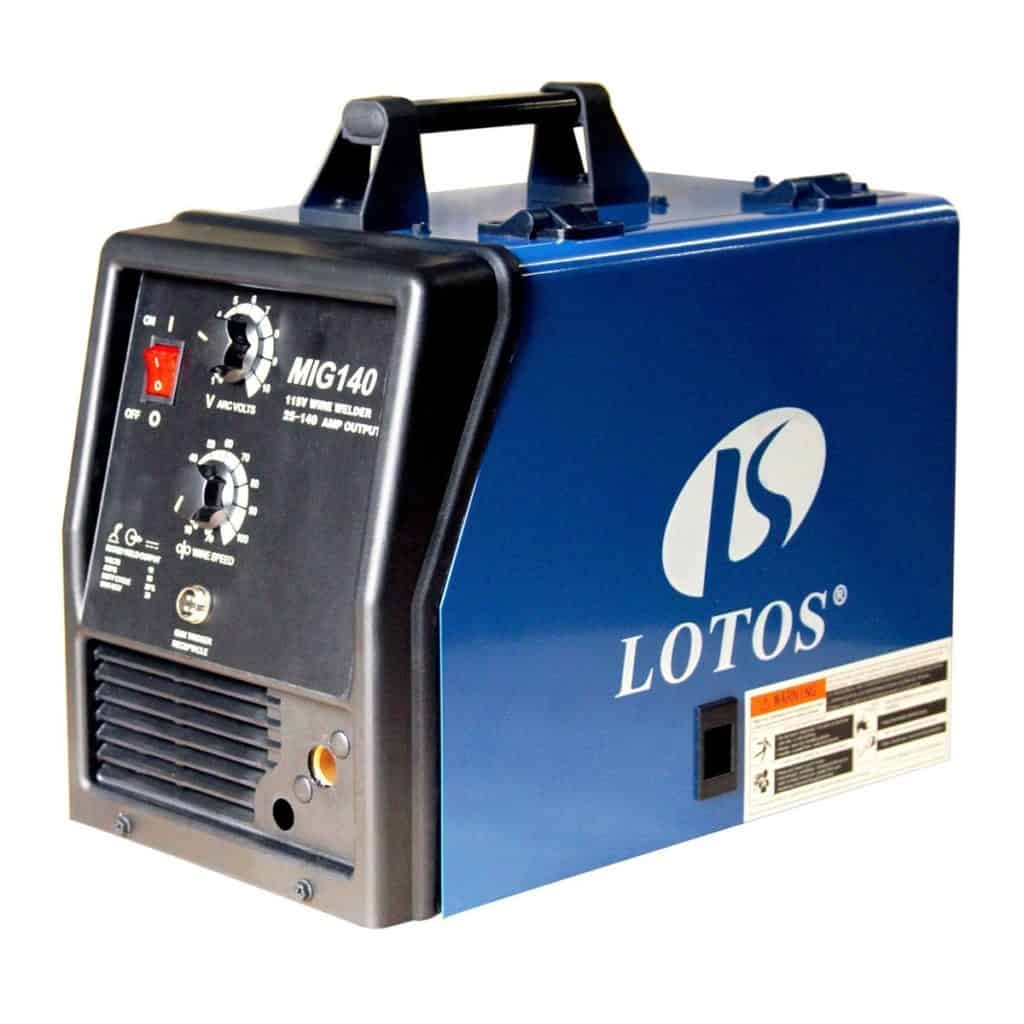
The Lotos MIG140 if an extremely affordable MIG welding machine for beginners, producing a power output of 30A – 140A and the ability to process a duty cycle of 20% at 90A is happily capable of welding at an industrial performance level. The perfect unit for beginners and DIY’ers alike, it’s extremely versatile and easy to store away in your garage or home shop.
Something not to forget about is that the Lotos MIG140 is also capable of handling flux-cored welding (something that many welding machines at this price range can’t do). Capable of welding multiple kinds of metals from 24 gauge to quarter inch thick sheet metal, stainless steel, aluminum. It also comes with an additional optional spool gun.
What kind of projects should the Lotos MIG140 be used for?
DIY projects
Small home projects
Auto body workshops
Light professional applications
Anyone looking to become more familiar with welding
Special Features of the Lotos MIG 140
Research against the market and other existing MIG welders on the market shows that this machine has multiple special features to make it more powerful for its money:
Thermal overload protection – used to protect the welders from overload and prevents the heating up due to overuse. It allows the lifespan of the tool to increase and increases durability during use.
Easy setup – designed to get this MIG welder working quickly.
Dual functionality for MIG and flux cored welding
Aluminum wire feeder – increased stability and convienece
Pros of the Lotos MIG 140 Welding Machine
Simple and easy to use. Easy to setup. Minimal hassle
Very light weight, portable, and stable compared to other MIG welders on the market
Very affordable
Cons of the Lotos MIG 140 Welding Machine
Gas cylinder not included with this tool, it is an optional but separate cost
Not compatible with generators
Not as advanced features as top welders
Cost & Warranty Related Concerns of the Lotos MIG 140
Lotos offers a 1 year warranty with this machine. It stipulates that if a defect is noticed with the machine that impacts its performance and materials, Lotos will personally repair the damages machine or simply replace it.
Welders salaries may vary depending on exactly where the welder is working location wise, what type of welding they are doing, and how many hours a week they are working. Welding is a very technical skill, and it’s one that pays well even in a hard economy.
If you are a welder who is trained in more recent technologies, you can expect to our earn a welder who is used to working with outdated technologies. Most welders work in a variety of locations ranging from outdoor spaces, indoor spaces, and even on scaffolding high off the ground.
To see the most up-to-date welding equipment click here
National Average Pay
The United States Department of Labor and The Bureau of Labor Statistics stated that in 2016 the average welders pay was just shy of 40,000 dollars. Of course, it important to keep in mind that this is just an average. There are welding professions that make much more than this and there are welding professions that make much less than this. It depends on your field of choice.
The welding industry employment is expected to increase roughly six percent between 2012 and 2022, which some sources state as being slower than other occupations. This is generally focused to welders who work with construction of bridges, buildings, and maintaining structures.
If you’re considering making your profession welding you’ll also probably want to consider finding out what the highest paying welding jobs are. It is also recommended that welders keep current on technologies in order to keep their job prospects trending upward. Below we have a list of the highest paying welding jobs categorized by pay.
Underwater Welders
How much do Underwater welders make?
This is one of the highest paying welding jobs for a reason. Underwater welders can make anywhere between $54,750 to $300,000 per year. The average underwater welder makes between $53,990 per year however, and makes $25.96 an hour.
It involves a fair amount of risk and is in relatively high demand because of that fact. This job requires you to weld under pressurized circumstances and to be comfortable doing so. Not only are underwater welders working in pressurized conditions, they’re also working with up to 400 amps of direct current at their disposal (and if we know anything about water and electricity we know they don’t mix well).
The largest determinant of underwater welder pay is their experience level (aka Diving experience). The second most important determinant of welder pay is their location.
Other factors that affect an Underwater welder’s pay are (in no particular order):
Depth of work: Saturation divers can make up to $90,000 a month and near $500,000 per year. These divers get something called “depth pay” which adds between $1 to $4 per foot. It’s typically $1 each 100 feet and then moves up to $2 a foot afterwards. Pay greatly depends on depth and length of the project and the tenure of the diver.
Distance offshore: Offshore underwater welders tend to make more than welders who stay inland / closer to the shore.
Off shore underwater pay
Rookie underwater welders (who go off shore) tend to have a starting pay of between $40,000 – $60,000.
Veteran underwater welders with between 3 to 5 years of experience tend to have salaries between $75,000 to $100,000 or more.
On shore underwater pay
Rookie underwater welders (who stay on shore) tend to have a starting salary of between $25,000 and $40,000.
Veteran underwater welders with 3 to 5 years of experience tend to have salaries between $50,000 to $80,000.
Overtime: One job that can pay very well with overtime is underwater welding. Why? Well, underwater welders tend to work well over 12 hours per day for up to 2 weeks in a row. During overtime pay tends to move up by 50%.
Dive methods: The term dive mode is used to refer to dives that require certain pieces of equipment and procedure. The less insulation a welder has from the environment (usually) means the welder will receive higher pay. The typical dive mode for underwater welding is through surface-supplied air. Other diving modes are:
Mixed gas saturation
Scuba
Underwater welding equipment: Usually, as a welder moves further from the coast, emergency medical services become scarce. While large ships and oil rigs must have diver emergency and first aid kits available, they won’t be able to offer long-term solutions to sicknesses such as broken bones and the bends. The more risk involved (as we can see) the higher a welders pay is.
Performance: A welder who produces high quality welds will typically have a better reputation than a welder who does not which will result in a higher salary for other projects.
Travel Frequency: The more you, as an underwater welder, are able to relocate the higher your earning potential is.
Education Level: As with most welding jobs the more degrees and certifications one has (from facilities that’re credible) the higher your propensity for salary bumps.
Employment Competition: The more competition you have (the more underwater welders/marine welders) the higher an employers pricing power (the less you’ll get paid).
Video credits to Weldtube. It shows you what Underwater Welders do.
Offshore Oil Rig Welding
How much do Offshore Rig Welders make?
The average (starting salary) for offshore oil rig welders can be as high $60,000 a year. And, as time goes on (usually a few years or so) an offshore oil rig welder can make as much $100,000 per year. The great thing about Rig Welding is that it is only an entry level position, usually. This is a great gig for any individual who would like to move up through the ranks in time.
What factors affect Offshore Rig Welder pay?
The factors that affect Offshore Rig Welder pay are:
Employer Demand
Geographic Location
Education Level
Certifications
Experience
https://www.youtube.com/watch?v=WRiYU87j1w8
Video credits to Kishore nair. It talks about how Offshore Rig Welders stay safe.
Aerospace Welding
How much do Aerospace welders make?
The average aerospace welder makes, on average, $28 per hour and between $37,906 and $68,763 per year. Aerospace welders are in such high demand because of the need for work on spacecrafts. This job is such a highly paid one because of the skill that is required.
What factors affect Aerospace Welder pay?
Factors that affect Aerospace welder pay are:
Certifications
Education
Secondary Skills
Tenure
Video credits to KRWGnews. It shows a welder at Nasa.
Industrial Pipeline Welding
How much do Industrial Pipeline Welders make?
In 2017, pipeline welders earned an average salary of $58,998. Pipeline welders essentially do the work that deals with our infrastructure. Regardless of the substance the pipe allows to travel through it (water, gas, oil) it’ sending something that we use currently.
Military Support Welding
How much do Military Support Welders make?
Military support welders can make between $160,000 and $200,000 depending on where they’re located.
What is Military Support Welding?
Military support welders are responsible for a number of things but the main jobs of a Military Support Welder are to maintain equipment, gadgets, and the transportation used by soldiers in combat.
Nuclear welding tends to offer pay on the higher end of the pay-scale (not to mention that certified underwater welders make more in this industry). Nuclear welder pay is so high because welders are willingly exposing themselves to radiation as well as fatigue themselves quickly because of their exposure to high water temperatures inside of reactors.
Nuclear Diver Welders have the potential to make between $100,000 to $200,000 per year. However, to make this dollar amount a welder must be highly skilled as they must be available (and able) to make repairs as quick as possible.
Why? Well, any nuclear reactor shut-down can result in the loss of several thousand dollars each minute it’s down.
Nuclear welders who don’t go underwater however (who don’t have diving certifications) tend to make salaries between $35,000 to $42,000 on average. These welders must still go through special safety training (as you’re exposing yourself to radiation).
Video credits to CGTN. It talks about the problems that nuclear power plants pose for welders.